




There is an interesting pattern in how the major players that Aras has on its customer list use the solution. In most cases, it is not the primary PLM platform of each company, but nevertheless plays an important role, notes Leon Lautritsen:
“Absolutely, Aras is unique in its ability to complement and extend the functionality of legacy PLM solutions. One of our strengths is helping organizations establish a strong backbone for the digital thread, which can bridge the many data silos that arise in complex product development operations.”
Management of 100 million Parts at the Nuclear Research Organization CERN
The fact that the solution is often complementary does not prevent it from being used as a heavy-duty and broad solution among many Aras Innovator users. Lauritsen mentions the nuclear research organization CERN and its facilities and operations, based in Switzerland, near Geneva.
“It’s a good example,” says Aras’ global sales director. “This European organization for nuclear research is dedicated to basic research in particle physics. They operate the world’s largest and most powerful particle accelerator, the Large Hadron Collider (LHC). CERN’s primary goal is to understand the fundamental constituents of matter and the forces that control them. For this, they have, among other things, a 27-kilometer-long ring-shaped tunnel where particles are accelerated to close to the speed of light. In total, it involves facilities and handling that includes over 100 million parts, which are handled in our solutions, among other things.”
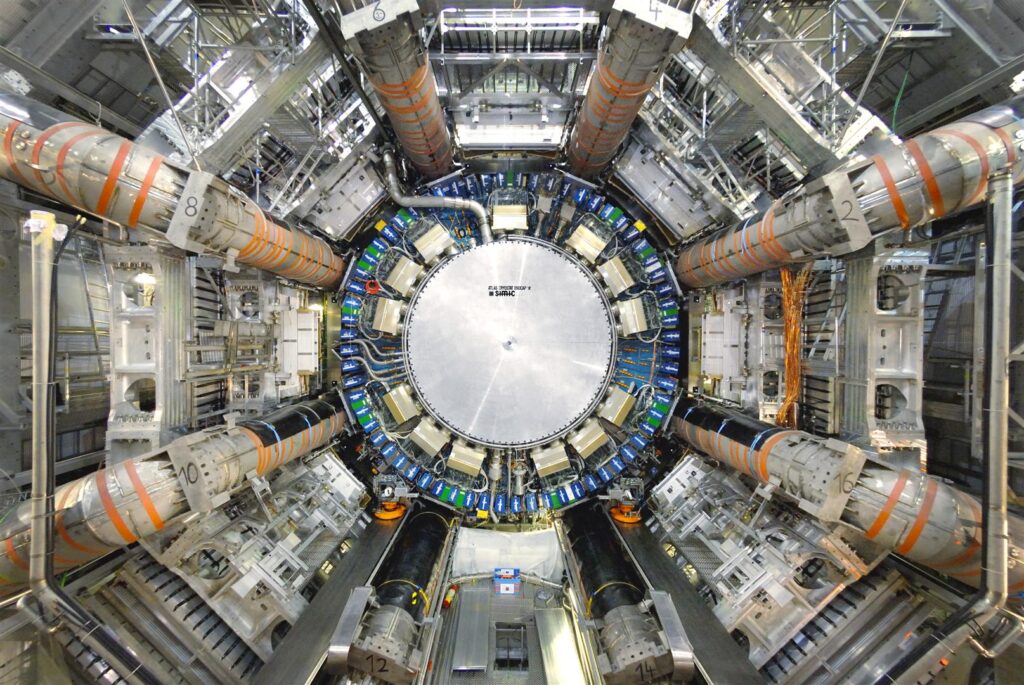
Anyone who has seen what the facility looks like–look at the image below–quickly realizes that the complexity is profound. Lauritsen says that Innovator enables CERN to track components, manage data and facilitate collaboration within its organization and with partners.
An interesting aspect is that the Innovator software works according to a CAD-agnostic and part-centric methodology. This allows for the management of components regardless of the CAD system used, which is crucial for CERN’s diverse projects.
Another aspect is the integration of digital twins: CERN is creating these digital twins in Innovator, which in future development stages will enable their researchers and engineers to simulate and predict the performance and maintenance needs of components.
“The platform is designed to handle massive amounts of data and complex technical challenges, making it suitable for CERN’s large-scale scientific operations,” notes Lauritsen, also pointing to Innovator’s cloud capabilities as a key.
“Exactly, Innovator is accessible via a web interface, which makes it possible for CERN’s global teams and partners to collaborate on projects from anywhere with a CERN account.”
By the way, CERN was one of the main presenters at Aras’ major user event ACE 2025, where they also highlighted Innovator’s capacity to integrate with the organization’s other systems, which is of course of great importance for creating a unified platform for data management and collaboration.
Free Download of the System Base – But What Does Aras Live On?
We mentioned in the introduction that Aras PLM has a slightly different business model, which Leon Lauritsen believes is of great importance for creating good economics in PLM investments.
A heavy point is that you can download a basic version of Aras Innovator free of charge for the first 50 users, which is well in line with the company’s open-source strategy. However, it would not be a possible deal if the entire functionality of the Aras package were included free of charge.
”No, that’s right. Aras is indeed free for up to 50 named users. This means that users can access the platform, explore its features and use many of the core applications without incurring any costs. However, it is important to note that even though our basic version contains a wide range of applications, there are certain services that are not available for free. But the most important conclusion is that individuals and organizations can still access the Aras solution, our platform and a variety of applications without having to pay.”
So what does Aras PLM live on? Above all, subscriptions, but also adaptations of the system and development of special modules for specific purposes. But the company’s subscription system is, asserts Lauritsen, a main point and is unique in the industry, as subscribers get access to all the platform’s functions within the framework of the subscription cost.
”This means that the system will be significantly cheaper than the models our competitors, such as Siemens, Dassault, PTC and others use, where you have to pay extra for specific functions; costs that are added on top of the ’normal’ subscription fee. This makes Aras Innovator cheaper, while you get all the functionality for free,” says Laurtisen, adding that via the Aras marketplace, there is a broad and capable solution market for partners with other various add-on functionalities. The latter is not free, however.
Upgrades Give Aras an Advantage, According to Analyst
When discussing Aras’ business model, one inevitably comes to an area where the company has a strong market advantage: system upgrades. This is an area that normally sends shivers down the spine of even the most hardened PLM enthusiasts. Why? It is often expensive and complex in a way that also means a loss of pace in the regular development work, notes Aras’ sales director.
”That’s true, but in our environment it is a different matter. First, the upgrades are free of charge as they are included in the ’subscription’ and second, we do not let go of an upgrade unless everything works as intended,” he says.
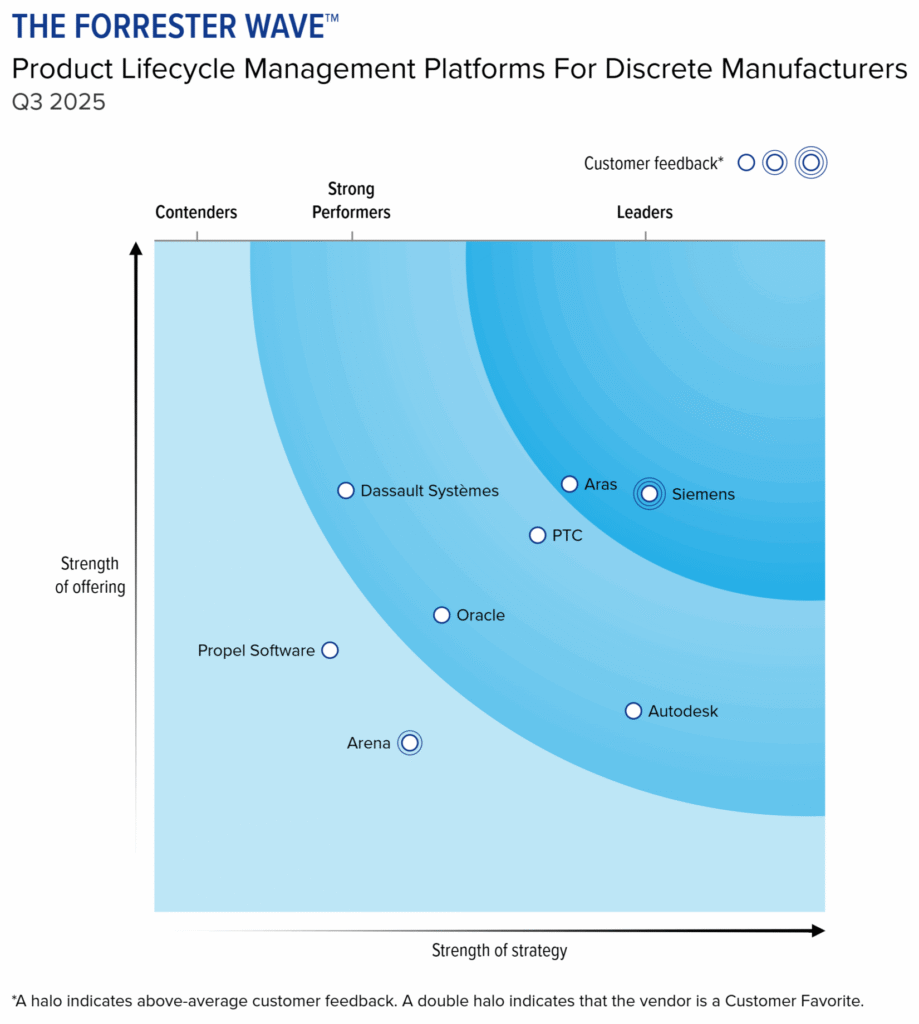
When it comes to system installations, the first basic implementation work is also an important thing to take into account. Leon Lauritsen even believes that it is a watershed from a market perspective. It is also interesting that he is supported by Forrester’s analysts in this. In the latest Forrester Wave for Q3 2025 (see image on the left), the analyst points out this as an advantage for Aras:
Aras PLM is praised, “for providing a community of innovators around a data-driven and AI-enabled approach to PLM. It demonstrates superior implementation compared to other vendors in our evaluation, with a focus on customer service that delivers net revenue retention of over 110%.” Not a bad score, then.
Transparency Across Supply Sources
Aras also receives Forrester praise for the platform’s functionality in terms of idea generation and requirements management, where it uses generative AI to analyze data sources according to requirements. The platform offers detailed solutions for testing connections for traceability as well as component technology functionality to integrate value networks/sourcing information.
“Aras also excels in sourcing with multi-level supply chain visibility and dependencies, and its reuse of parts or subassemblies and CTO embeds AI to maximize reuse. Its superior process description offers standardized or facility-specific process descriptions and work instructions that are ready for the shop floor,” Forrester further writes in the evaluation.
Overall, a capable PLM solution, according to the analyst. But there’s also a customer perspective: Some customers “mention that they need to develop more technical sophistication to tailor their offering to specific needs.”

The Partnership With Ansys Is The Ultimate Proof Of Capability
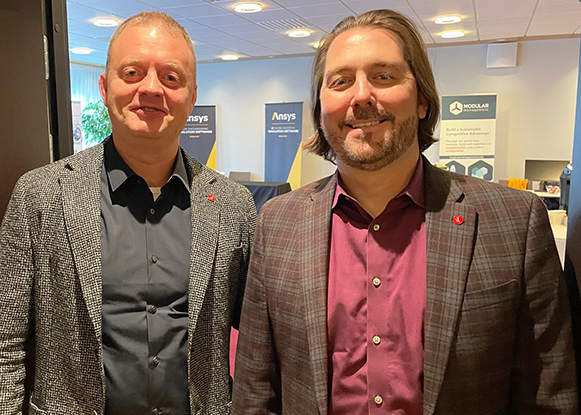
Finally, Leon Lautritsen notes that a kind of ultimate proof of the high class of the Innovator solution, alongside Forrester’s latest Wave, is that the market leader on the simulation and analysis side, Ansys, actually selected the Aras platform as its technological PLM base a few years ago. The partnership agreement from 2020 is that Aras licenses its lifecycle-based platform technology to ANSYS. This means that Ansys uses this technology to develop dedicated solutions in configuration management, PDM/PLM interoperability, API integration and has also added simulation-specific functions to deliver scalable and configurable products that connect simulation and optimization to engineering and development activities.
Technologically, things are looking bright for Aras, this competitor to the big industry elephants. Or as Forrester sums it up in its evaluation of PLM for discrete manufacturing:
“Ara’s solutions are best suited for very large manufacturers with complex products and the ability to support distinct features in their PLM instance.”
A good rating, although it seems a bit difficult for Leon Lauritsen, Aras CEO Roque Martin, CTO Rob McAveney, and their teams to get rid of the ”primarily-serving-as-a-complementary-solution” label. However, they are working hard on it.

