




Annons

A Major Pre-Silicon Breakthrough: Siemens & NVIDIA Propel AI Chip Verification to Trillion-Cycle Scale

Jean-Marie Brunet, VP Siemens Digital Industries Software: ”Meeting the stringent verification and validation demands of highly complex AI/ML SoCs.”
Siemens and NVIDIA today announced a massive breakthrough in hardware verification, capturing trillions of pre-silicon design cycles in just days. By pairing Siemens’ Veloce proFPGA CS with NVIDIA’s performance-optimized chip architecture, the duo has effectively shattered the time and resource constraints that once stalled the development of complex chips and AI systems.
Traditional pre-silicon verification—the crucial process of testing chip designs before physical manufacturing—has long been a notorious bottleneck. Yet, according to Jean-Marie Brunet, Senior VP and GM of Hardware Assisted Verification at Siemens Digital Industries Software, the game is changing. By pairing Siemens’ Veloce proFPGA CS hardware-assisted verification system with NVIDIA’s performance-optimized chip architecture, they are achieving breakthroughs that dramatically push the boundaries of what is possible in design verification.
"Indeed, our collaboration spans numerous areas, most recently focusing on the development of hardware-assisted verification methods, specifically FPGA-based prototyping, to meet the stringent verification and validation demands of highly complex AI/ML SoCs," says Brunet. He adds that "Veloce proFPGA CS addresses these challenges by combining a highly flexible, scalable hardware architecture with an advanced, intuitive implementation and debugging software flow."
Ultimately, this enables users to maintain the optimal validation solution for both individual FPGA IP and multi-billion gate chiplet designs.
Broadly speaking, pre-silicon design cycles encompass all development stages occurring before an integrated circuit or chip is physically manufactured in silicon. This phase of semiconductor design involves engineers working with digital models and simulations to ensure the chip functions exactly as intended. Because correcting errors after chip manufacturing (post-silicon) is extremely expensive and time-consuming, vast resources are dedicated to finding and resolving issues during these cycles.
Today’s announcement from Siemens and NVIDIA is, to put it mildly, fascinating. Simply put, this partnership has conquered a task once deemed impossible. By capturing tens of trillions of cycles in just a few days—powered by Siemens’ scalable, performance-optimized Veloce proFPGA CS hardware architecture and combined with NVIDIA’s high-performance chip architecture—they have achieved a level of scale that experts believe is essential for the next generation of AI.
Siemens Digital Industries Software, through its EDA division, holds a dominant position in the AI chip verification market. Recognized by analyst firm Frost & Sullivan as a 'star player' driving innovation, the company stands out for its hardware-assisted verification platforms and AI-driven software tools. Consequently, Siemens is firmly established alongside Synopsys and Cadence as one of the industry's 'Big Three'.

In an era of exponential computational growth, optimized verification is no longer merely an advantage—it is a prerequisite. By accelerating the AI/ML-SoC development cycle, innovators can dramatically slash time-to-market and reduce costs, all while securing the performance and energy efficiency required by tomorrow’s complex applications. In short, faster and more secure AI SoC development is essential to meeting the surging demand for more intelligent, efficient, and reliable devices, making it an economic imperative for staying competitive.
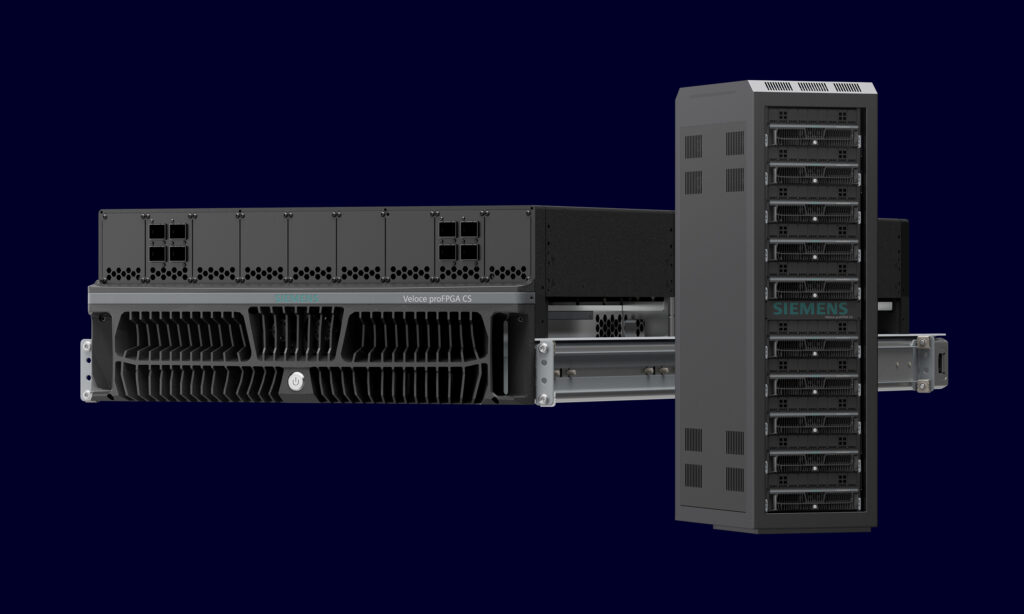
Siemens and NVIDIA have achieved a major verification breakthrough, capturing trillions of pre‑silicon design cycles in days using Siemens’ Veloce proFPGA CS combined with NVIDIA’s performance-optimized chip architecture. This enables faster, more reliable AI/ML system-on-a-chip (SoC) development, giving NVIDIA’s teams confidence to run large workloads and optimize designs before first silicon

The Imperative for High-Performance Verification
”As AI and computing architectures reach new heights of complexity, semiconductor teams require high-performance verification solutions to validate massive workloads and accelerate time-to-market,” says Narendra Konda, VP of Hardware Engineering at NVIDIA. By integrating NVIDIA’s performance-optimized chip architectures with the Siemens Veloce proFPGA CS, designers can now capture trillions of cycles in a matter of days—delivering the necessary scale to ensure reliability for the next generation of AI.
FPGA-based prototyping systems offer blistering speed, allowing users to execute pre-silicon verification workloads in a fraction of the time required by traditional simulation or even emulation. Yet, modern AI/ML designs are demanding even more, driven by a perfect storm of increasing hardware complexity and ballooning software demands.
Scaling to satisfy rigorous industry demands, accelerated time-to-market targets, and stringent reliability requirements now hinges on the capability to execute trillions of design cycles rapidly. Conventional verification methods, such as simulation and emulation, have reached their limit, unable to scale beyond millions—or, at best, a few billion—cycles within a feasible turnaround time.

The Key Parts of a Pre-Slicon Design Cycle
Finally, a few words about pre-silicon design cycles, which refer to all the development steps that take place before an integrated circuit or chip is physically manufactured in silicon.

Here are the key parts of a pre-silicon design cycle:
* Architecture and specification: You define what the chip will do, its performance goals, and which components are needed.
* RTL design (Register Transfer Level): The design is written in a hardware description language (such as Verilog or VHDL). This is where the ”blueprint” of the chip’s logic is created.
* Verification: The most time-consuming phase. This is where simulations are used to test that the RTL code actually does what it is supposed to do in all possible scenarios.
* Emulation and FPGA prototyping: Special hardware is used to run the design at high speed (but still before manufacturing) in order to start developing software and drivers early.
* Physical Design (Layout): The digital logic is translated into a physical map of how transistors and wires should be placed on the silicon wafer.
* Sign-off: The final check where the design is verified to meet all technical requirements (timing, power consumption, manufacturability) before it is sent to the factory (so-called ”tape-out”).

In short, it is the virtual birth of a chip where software tools are used to ensure that the hardware works perfectly once it becomes reality.

Print Friendly, PDF & Email

Success Stories

Success Stories

Industriellt

Intressant på PLM TV News

Aktuell ANALYS

Aktuell Analys

Aktuell Analys

3D-printing

Block title