




In its comments on the 2025 figures, the DS base noted that despite the flat figures, Dassault “continues to win with existing customers and displace competitors.”
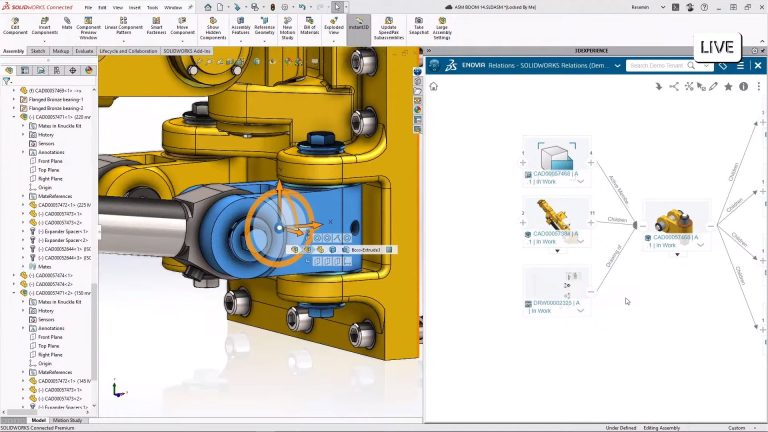
That said, it is worth noting that SOLIDWORKS, the world’s leading mainstream CAD solution, continued to perform well, as did the 3DEXPERIENCE apps with CATIA (CAD), SIMULIA (CAE), and ENOVIA (PLM/PDM) which saw Industry Innovation programs increase revenue by 6%.
A brilliant Future for Medidata?
Daloz further noted that “while it looked tough for Life Sciences for Medidata, the opportunity for what lies ahead is transformative: moving from document-based processes to the virtual twin of the pharmaceutical industry, a groundbreaking strategy that unlocks unprecedented efficiency, quality and compliance.”
It’s also not hard to agree with Daloz about the great potential on the Life Sciences side. How so?
Clearly, the pulse in global medicine is increasing as a near-perfect storm of technological breakthroughs and economic strength propels the Life Sciences industry towards a proactive, hyper-personal future.
The transformation of global healthcare through data-driven intelligence is being driven by a convergence of rapid technological advances, acute economic pressures and a fundamental shift towards proactive, personalized care. As the industry moves from pilot programs to scalable AI implementation by 2026, the key drivers are focused on using data to improve outcomes, reduce administrative burden and secure, connected systems.

The Data Deluge: How Life Sciences and AI are Redefining the Digital Frontier
The life sciences and healthcare sectors have evolved into the world’s most prolific data engines. Today, these industries generate approximately 30% of the global data volume—a staggering figure driven by the rapid digitization of electronic health records, high-resolution medical imaging, and the proliferation of the Internet of Medical Things (IoMT).
This ”data explosion” shows no signs of slowing. Analysts project an annual growth rate of 36% through 2025, signaling a fundamental shift in how medical intelligence is gathered and utilized.
According to Ashish Kolte, a market research expert at DataIntelo and upcoming guest columnist for PLM&ERP News, we are witnessing an unprecedented era of expansion. The global healthcare analytics market, valued at $46.6 billion (USD) in 2023, is on a trajectory to more than double by 2032. This represents a robust Compound Annual Growth Rate (CAGR) of 23.3%.
For industry leaders, this isn’t just about volume; it’s about the digital transformation of global healthcare systems. The challenge—and the opportunity—lies in turning this mountain of raw data into actionable medical breakthroughs.
A Power Couple: Dassault Systèmes and NVIDIA
A pivotal moment in this transformation is the deepening partnership between Dassault Systèmes and NVIDIA. Together, they are moving beyond simple data processing toward the creation of scientifically validated ”industry world models.”
While traditional AI has often been reactive—think of the standard chatbot answering a query—this collaboration focuses on the next frontier: Agentic AI.
Agentic AI is about an advanced software environment designed to create and deploy autonomous AI agents. Unlike their predecessors, these agents can plan, reason, and execute complex, multi-step workflows without constant human intervention.
The shift toward agentic platforms represents a paradigm change for the life sciences:
- Autonomy: Agents can coordinate multiple tools to achieve long-term goals.
- Scientific Precision: By leveraging NVIDIA’s computing power and Dassault Systèmes’ virtual twin technology, these models ensure that AI outputs are grounded in physical and biological reality.
- Complex Problem Solving: From drug discovery to clinical trial optimization, these systems act as ”digital colleagues” that can navigate intricate workflows independently.
As the volume of healthcare data continues to surge, the integration of these sophisticated AI agents will be the differentiator between companies that merely store data and those that harness it to redefine the future of medicine.
Highlights of Dassault’s AI initiative with NVIDA
Dassault Systèmes’ AI initiative with NVIDIA focuses on integrating generative AI and advanced simulation techniques into its 3DEXPERIENCE platform, with the goal of transforming industrial design, manufacturing and Life Sciences. The collaboration is based on combining Dassault’s extensive industrial data and virtual twin capabilities with NVIDIA’s graphics processing units (GPUs) and AI software platforms. Here are the key points of the collaboration:
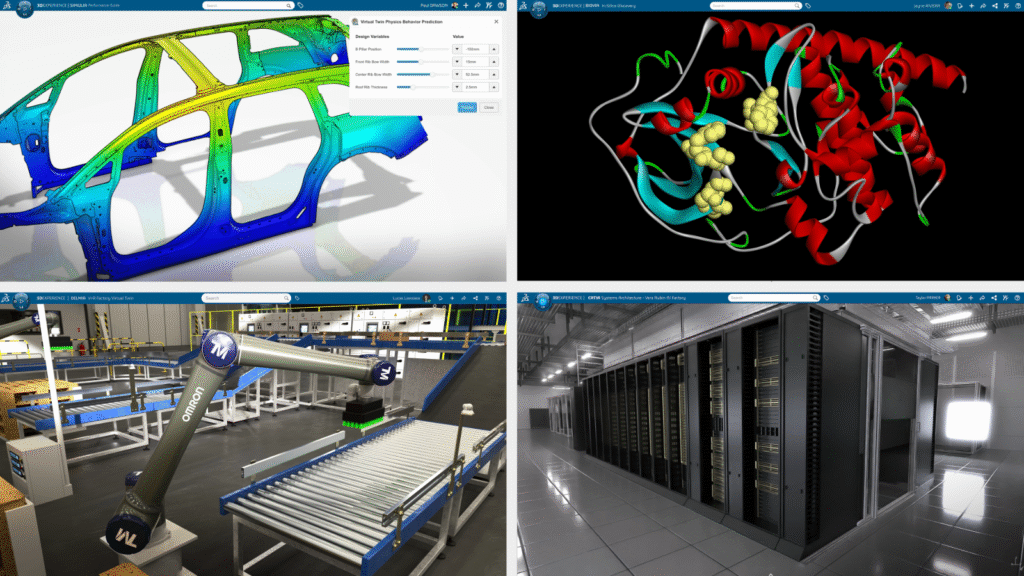
• Virtual Twin experiences with NVIDIA Omniverse: Dassault Systèmes will integrate NVIDIA Omniverse into its applications, enabling companies to create, simulate and run physically accurate “virtual twins” of factories, products and complex systems in real time.
• Generative AI for 3D design: Using NVIDIA AI platforms (including NeMo and BioNeMo), Dassault is enhancing its solutions to generate optimized 3D models and simulation bases. This helps engineers quickly explore thousands of design options based on specific performance requirements.
• Optimized simulation and performance: The collaboration aims to dramatically speed up simulation processes. NVIDIA DGX Cloud and GPU technology enable complex simulations (e.g. aerodynamics or structural analysis on the SIMULIA platform) to be performed significantly faster than traditional methods.
• Focus on “Industrial AI”: Instead of general AI, the collaboration focuses on specialized AI models for industry. This involves training the AI on Dassault’s deep engineering and materials science databases.
• Life Sciences and Molecular Modeling: The collaboration also includes the BIOVIA brand, where NVIDIA BioNeMo is used to accelerate drug discovery and molecular simulation, which can shorten development times for medical solutions.
In summary, the collaboration is designed to make virtual twins more intelligent, interactive and predictive by leveraging NVIDIA’s hardware and software directly within Dassault Systèmes’ industry-leading software.
Dassault Systèmes’ AI effort with NVIDIA, which intensified in early 2026, is based on a long-term strategic partnership to create an industrial AI platform. The goal is to combine virtual twins with physical AI to move simulations from offline to real-time.
Why was the stock market so concerned about Dassault’s report?
While Dassault Systèmes’ 2025 results met the bare minimum of expectations, a tepid outlook for 2026 has ignited a deeper existential debate: Is the champion of industrial software a winner or a victim in the age of Generative AI?
When the dust settled on Dassault Systèmes’ latest financial report, the market reaction was nothing short of brutal. The share price plummeted as investors scrambled to digest a set of projections that seemed to stall the momentum of the French software giant.
On the surface, the 2025 figures were respectable, if uninspired, landing squarely at the lower bound of previous guidance. However, it was the 2026 forecast that sent shockwaves through the analyst community. Dassault projected revenue growth of just 3–5%, falling short of the nearly 6% consensus. With an estimated operating margin (non-IFRS) of 32.2–32.6% and earnings per share between €1.30 and €1.34, the math for the company’s long-term targets no longer adds up easily. To hit its ambitious 2029 goal of 7% annual growth, Dassault would now need to accelerate to a blistering 8–9% clip in the final years of the decade—a tall order for a legacy incumbent.
Structural Winner or Legacy Victim?
The anxiety surrounding Dassault stems from its pivotal role in the European industrial complex. Its PLM tools—often pioneering 3D design, simulation, and ”virtual twins”—are the nervous system for the aerospace, automotive, and life sciences sectors. For years, Dassault worked hard to establish the reputation, right or wrong, as the ”structural leader” of the digital transformation era.
But the rise of Generative AI has moved the goalposts. Despite Dassault’s vocal promotion of ”industrial world models” and its high-profile partnership with NVIDIA, investors are questioning the durability of the traditional industrial software stack.
The market is currently bifurcated: while AI infrastructure providers (the ”shovels” of the gold rush) have seen their valuations skyrocket, Software-as-a-Service (SaaS) firms are facing a ”SaaS Apocalypse.” The fear is that AI will compress pricing power, automate away billable workflows, and erode traditional licensing revenues.
For Dassault, the central question is one of timing and transition. Will its proprietary models hold their own against emerging AI-native disruptors? And more importantly, when will these advanced ”virtual twin” innovations translate into incremental profit? Another challenging problem is that DS’ tough competitor and the present commercial PLM leader, Siemens Digital Industries Software, also has established a tight partnership with NVDIA; as have several other competitors like Ansys and PTC.
As growth slows and the ”SaaS Apocalypse” trade gains momentum, Dassault Systèmes finds itself at a crossroads. It must prove that it can not only integrate Generative AI but also monetize it effectively enough to offset the slowing growth of its core business. Until then, the market seems content to treat even a minor guidance miss as a major red flag.

