
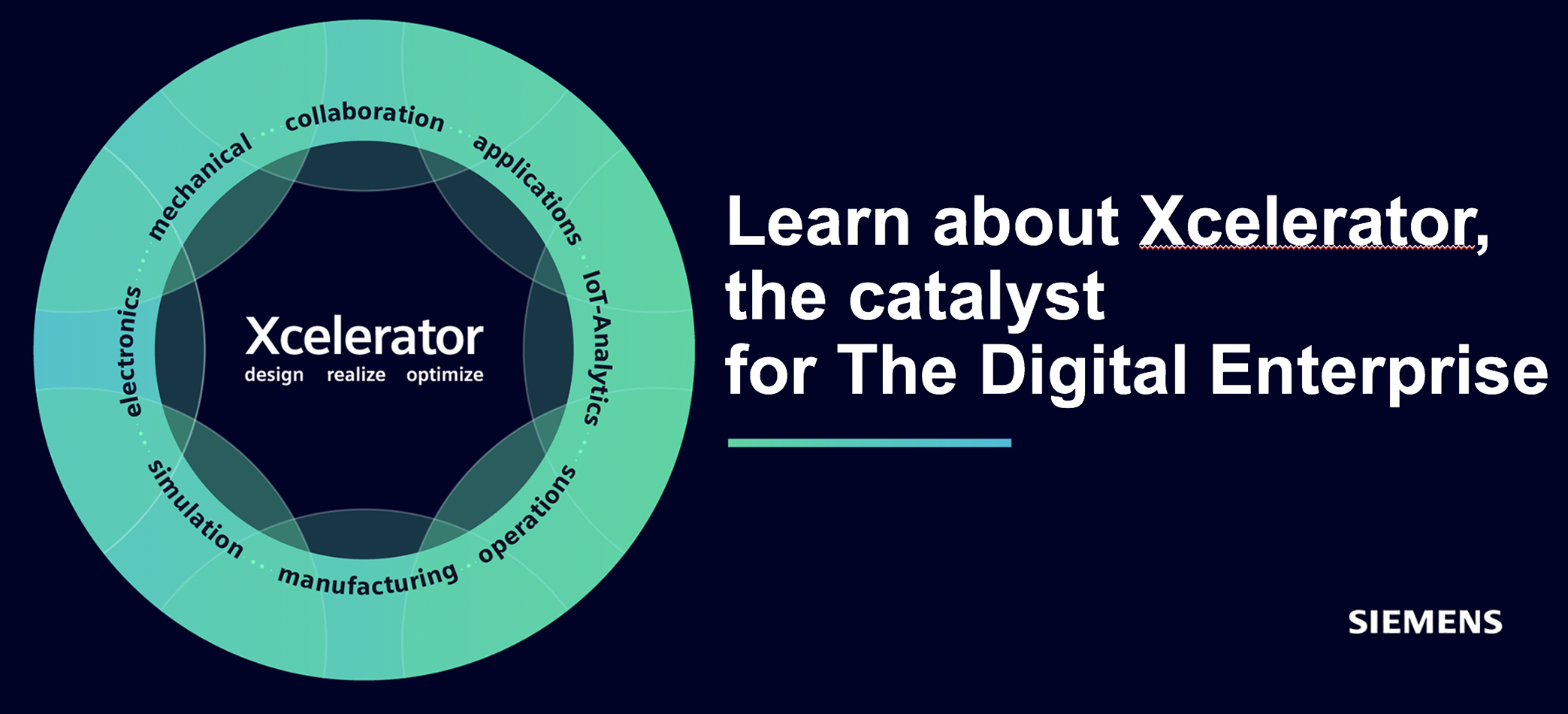



…but the company faces TOUGH COMPETITION from ARAS PLM and DASSAULT SYSTEMES. Vision and strategy are some of the strongest driving forces when it comes to developing technology. The PLM area is no exception and there has been something of a shift here in recent years, where an interesting trend is that Siemens Digital Industries Software is increasingly emerging as a visionary and strategic PLM leader; a role previously held by Dassault Systemes under the long-standing former executive director, Bernard Charles. Today, the positions tend to have been reversed, which in many ways parallels Tony Hemmelgarn’s leadership of Siemens’ PLM division. Hemmelgarn has a strong vision for the overall product development process, where in particular things like electricity/electronics, software development and AI, in parallel with deep integration of mechanics and connections to the simulation pieces and what he calls ”the comprehensive digital twin”, have been implemented in the Xcelerator PLM portfolio. All garnished with strong, seamless connections to the manufacturing side, where Siemens has already been the leading solution developer for years.
The image of Siemens’ strong vision and strategy as the clear market leading concept is today confirmed by the analyst Forrester, in their evaluation, ”The Forrester Wave: Product Lifecycle Management Platforms For Discrete Manufacturers, Q3 2025”. Siemens is positioned in this as the market player that has come the furthest in the ”leadership wave”; with recent years challenger Aras PLM (Innovator platform), as the only other competitor, qualified for the leadership wave. Both also receive good grades in terms of the strength of the existing technology offering; here Aras lands at an 3.58 average on Forrester’s five-point scale, while Siemens gets 3.52. In this case, Dassault Systemes also ends up high with 3.54, however, they are outside the ”leadership wave”, placed in the second highest, so-called ”contender wave”.
The background is that discrete manufacturing is the part of the product realization process that involves assembling various components into finished products such as smartphones, cars, electronics, furniture, etc. In contrast process manufacturing is about mixing ingredients to create chemicals, plastics, pharmaceuticals, beverages and food, etc.
In their evaluation, Forrester, among other things, notes that Siemens has important customers such as General Motors and the US Air Force, and that, “It uses SysML and OSLC to offer bidirectional integration with popular design tools. Other areas of differentiation include its built-in software connection to the Model-Based Systems Engineering (MBSE) digital thread, which ensures that product changes drive software changes and vice versa.”
Aras PLM is praised for “superior implementation compared to other vendors in our (Forrester) evaluation, with a focus on customer service that delivers net revenue retention of over 110%.”
But how are other well-known PLM players like Dassault, PTC, and Autodesk judged?
Regarding the vertical axis in Forrester’s Wave graphic it characterizes the current technical capability offering of each company; based on 29 separate areas. These cover things like design tool interoperability, generative design, traceability, the digital thread, collaboration, material sourcing, and tools for embedded software and regulatory compliance, etc. Each such sub-item has been rated on the five-point scale, after which the average of each player has been calculated, which then controls the vertical positioning in the graphic.
To provide a fair picture, Forrester has weighted the importance of the 29 various sub-items in percentages, where, for example, tools for reusing parts or sub-assemblies and support for CTOs, generative design and sourcing have been valued highest as a percentage of the whole with 6%, while, for example, tools for contract manufacturing and multidisciplinary PDM have been valued lowest with 2% shares of the whole.
The same principles apply to the horizontal axis in the graphic, which depicts the visionary strength of the company solutions. Here, however, “only” seven different areas have been used in the rating.
In this context, we should also note the difference between “vision” and “strategy”: While a vision is an overall, inspiring description of a desirable future, a strategy is a plan for how to achieve the vision. The vision answers the question “Where do we want to be?”, while the strategy answers the question “How will we get there?”.

Top marks for Siemens in key capability areas
Siemens has received the top score, 5.00, on seven of Forrester’s 29 items on the “current offering” side. Among other things, Siemens receives the top score on tools for key areas such as the digital thread, embedded software, and BOP (Bill of Process). The BOP is a process list, a detailed document that describes the specific steps, resources, and instructions required to manufacture a product. It is essentially a roadmap for production, describing the sequence of operations, the tools and equipment needed, the work involved, and quality control measures.
Of course, the BOP is a key capability in discrete manufacturing, just like the other two examples above, the digital thread and embedded software, are examples of areas that are valued higher in accordance with their relative greater importance.
What isn’t clearly expressed in Forrester’s evaluation is the capabilities connected to Siemens comprehensive digital twin concept, pointed out by CEO Tony Hemmelgarn as the most important foundation when it comes to digital product realization. This solution’s integration with every part of what the Xcelerator portfolio can offer is unique.
Regarding Forrester’s assessment of the seven points that form the basis for the company’s placement on the strategy axis, Siemens receives a top score of 5.00 on more than half of the points (4); including for innovation, roadmap, and partner ecosystem.
On the “strategy” side, the analyst further notes that “Siemens is reinforcing its vision to transform the PLM foundation for smart manufacturing with a pragmatic and transparent roadmap. Its differentiated innovation strategy leverages its venture capital firm Next47, which has over $1 billion in capital” – ten times that much in SEK – “while its partner ecosystem has 25,000 certified professionals at global system integrators. Its pricing flexibility and transparency are also impressive, with self-service licenses, perpetual and subscription licenses, and academic or startup pricing.”
On the feature side, the analyst’s assessment is that, “Siemens’ commitment to innovation pays off with many superior features.”
Very good ratings and the strongest customer feedback are also a distinctive feature of Forrester’s evaluation. ”Reference customers unanimously support Siemens’ continuity of support, security, clear communication, customer service and problem resolution. All say they would buy from the supplier again. Siemens is a customer favorite in this evaluation,” the area is summed up, adding that the analyst’s own view on the matter is that, ”Siemens Teamcenter X is best suited for global manufacturers that are laying the foundation for a portfolio of manufacturing applications that support agile or small-scale production.”
Overall, Forrester says Siemens is working with its corporate R&D group to deliver industrial AI to the factory floor, enabling secure access to large language models, real-time decision-making for operators, and product or process simulations.

Aras excels at sourcing and managing supply chains
With customers such as Airbus and General Electric, Aras offers the PLM platform Innovator, an open source software solution for enterprises. Forrester also writes that Aras provides subscription-based services for technical support, software updates and consulting. It therefore lives mainly on commercial revenue generated by customizations of and module additions to the platform.
Aras was also included in the leadership wave in the corresponding 2023 Wave graphic from Forrester, and it remains in the top wave in the latest 2025 Q3 version.
The company’s vision, according to the analyst, is, “to provide a community of innovators with a data-driven and AI-enabled strategy for PLM. It shows superior implementation compared to other vendors in our evaluation, with a focus on customer service that provides a net revenue retention of over 110%.”
Aras is also praised for the functionality of the platform in terms of idea generation and requirements management, using generative AI to analyze data sources to requirements. The platform offers detailed requirements for testing connections for traceability as well as component technology functionality for integrating value networks/sourcing information.
“Aras also excels in sourcing with multi-level supply chain visibility and dependencies, and its reuse of parts or subassemblies and CTO embeds AI to maximize reuse. Its superior process description offers standardized or facility-specific process descriptions and work instructions that are ready for the shop floor,” Forrester further writes in the evaluation.
The solution also receives some customer praise, but some customers, “mention that they need to develop more technical sophistication to tailor their offering to specific needs.”
Forrester summarizes Aras’ solutions as “best suited for very large manufacturers with complex products and the ability to support distinct features in their PLM instance.”

Both PTC’s Windchill and Dassault Systemes 3DX
have fallen out of Forrester’s leadership wave
This time, both Dassault Systemes 3DEXPERIENCE solution and PTC’s Windchill end up in somewhat more bearish wave positions, i.e. outside the leadership wave. Both were included in the leadership wave in 2023 and have thus fallen down to the so-called “challenger wave”, which is the second highest in Forrester’s Wave graphic.
PTC Windchill, with customers including Boeing and NASA, anyway, “has a solid strategy overall, while its supporting services and offerings stand out: They include popular applications for authoring, computing, IoT and service, and an Innovators’ Program.” Relevant in the manufacturing context is PTC’s Navigate applications for manufacturing and service/PLM integration.
Functionally, Forrester says traceability, with OSLC-based integration with tools like Jira, stands out, “while its superior data sources include operational engineering and customer feedback.”
Other strengths highlighted include its embedded software, contract manufacturing, supply chain and service solutions. However, sales and marketing use cases lag behind, as live content for generative AI is still lacking.
In the ALM area (Application Lifecycle Management), Forrester does not emphazie and give PTC’s ALM portfolio with Codebeamer, Pure Variants and PTC Modeler, the value they deserve. These are strong solutions that drive model-based systems engineering, requirements management, product line development, risk management, test management and entire product development workflows.
However, Forrester notes that a strength of PTC’s solutions is the integration with the PLM system (Windchill).

Dassault Gets Praise for Its Innovation Strategy, But Criticism for the Deliveries
Dassault Systèmes has almost all the world’s major engineering companies on its customer list, but Forrester still mentions Airbus and Ford.
They also praise Dassault’s innovation strategy, saying it is excellent, ”with enormous resources and a track record of success.” However, they failed to report deliveries or dates in their roadmap, which in itself has often been a weakness with Dassault’s solutions. The company has previously, during Bernard Charles’ years at the executive helm, always been at the top in terms of vision, while a weakness during these years has often been in exactly what Forrester points out: late or unclear delivery dates for innovations or new solutions. ”Dassault did not provide information on other strategic areas, such as the depth of its partner ecosystem or its retention and h churn rate. Their pricing is also overly complex, resulting in a subpar score,” Forrester writes in its summary.
In any case, the analyst believes that, “Dassault offers solid functionality in most areas. It excels in requirements management, which includes end-of-life requirements, as well as its product and customer data sources. It offers attribute sharing for interoperability between design tools, while generative design assigns relative weights to design goals. Other superior features are collaboration, which offers detailed co-simulation; cross-disciplinary PDM extensibility that links designs across disciplines; engineering change management, which includes workflow and impact analysis; and sustainability, where it offers guidance in the early design phase. However, it has not integrated stage gate management with FMEA, value network/sourcing information lacks details on aggregator integration, and it did not specify public cloud certifications, standards, and protocols for its platform—resulting in subpar scores for all three criteria.”
Forrester’s view of Dassault is that the company is “best suited for sustainability-focused manufacturers that use innovative generative design to balance sustainability, product cost, and performance goals.”

“Autodesk needs to catch up in several areas”
Finally, Forrester has taken a closer look at Autodesk (AD), with customers such as ME Global and Wallbox, and its Design & Make platform. Autodesk is primarily known for its products for the manufacturing, construction and media industries, but is also present on the engineering and product development side. In terms of PLM Autodesk traditionally hasn’t been a leader and the discussions during the summer around a bid on PTC, is a reminder that this area need some improvement before AD can become a really strong PLM contender. So far, their definite strength is concentrated to the AEC area. Its products include AutoCAD, Inventor, Vault, Revit for building information modeling, and Fusion for product design and manufacturing.
Strategically, Autodesk’s approach is to create a complete digital twin of the factory from planning to operations, applying AI-driven workflows, insights and automation to unlock additional value.
“Its innovation strategy is impressive and demonstrates the effective use of a large R&D budget. Pricing is also outstanding, with subscription-based, usage-based, capacity-based, and account/project-based options,” Forrester writes.
On the feature side, the analyst points to the integration of material or sourcing libraries, which excels by applying AI to part information, while superior platform features include high availability, scripting, and regression-tested REST APIs.
However, Autodesk needs to catch up in several areas: Generative AI is lacking in idea generation and requirements management, while they lack a traceability matrix.
Forrester sums up Autodesk’s business by saying that the company is best suited for construction and engineering companies that can use their powerful media capabilities to secure customer feedback before making manufacturing decisions.

