


AI Copilots and AI Agents – What’s the Difference?
The enthusiasm about what Philomin can bring to Siemens Digital Industries Software was also great in Amsterdam during the Realize Live event. AI is one of the most important pillars in the company’s development line, not least accentuated by the recent 10.6 billion acquisition of AI, simulation and HPC specialist Altair Engineering.
”It’s a development that requires your agility, flexibility and ability to act lightning fast,” he said and continued:

“Our two companies, Siemens and Altair complement each other almost perfectly. What we didn’t have, they have,” Jones said, adding that they are scaling up and expanding rapidly across all AI-powered offerings. This currently includes 35 applications – including the award-winning Industrial Copilot, but the development of agentic AI, built on AI agents, is also a high priority.
But what is the difference between copilots and agents? Both are of course types of AI systems, but they differ in their level of autonomy and how they interact with users. Copilots act as assistants and provide support and suggestions within a specific workflow, while agents are designed to operate more autonomously, handle tasks independently and often automate entire processes. Think of copilots as tools that enhance human capabilities and agents as solutions that can perform tasks with minimal human intervention.
It is worth noting in the reasoning that agentic AI can be seen as the framework; while AI agents are the building blocks within the framework. These agents, or “software packages with the capacity to solve various tasks,” are intended to use sophisticated reasoning and iterative planning to autonomously solve complex problems in multiple steps.
“But they are,” as Siemens Teamcenter chief, Joe Bohman, pointed out in Amsterdam, “nothing that is driven solely by the much-touted big language models. More is needed, why? Engineering work is specific, it varies in methodology, it works differently in different cultural environments and across both domains and individual business models. This requires consistent data in which a good PLM system, good methodology and logically coherent approach become crucial. In short, AI without a sharp and well-organized PLM backbone does not have the right conditions to deliver the enormous productivity development efficiency that AI promises.”
Making Complexity a Competitive Advantage
In this context, Bohman emphasized how complexity can look at the large-scale level, where electronics, electricity, software, and mechanics must interact, and how crucial areas like BOM (Bill of Material) management in practical product development work complicates engineering work enormously:
“A state-of-the-art larger ship can involve something like 100 million different types of signals to be controlled, 500 million lines of code, and 100 million BOM lines. How do you handle these staggering volumes?”
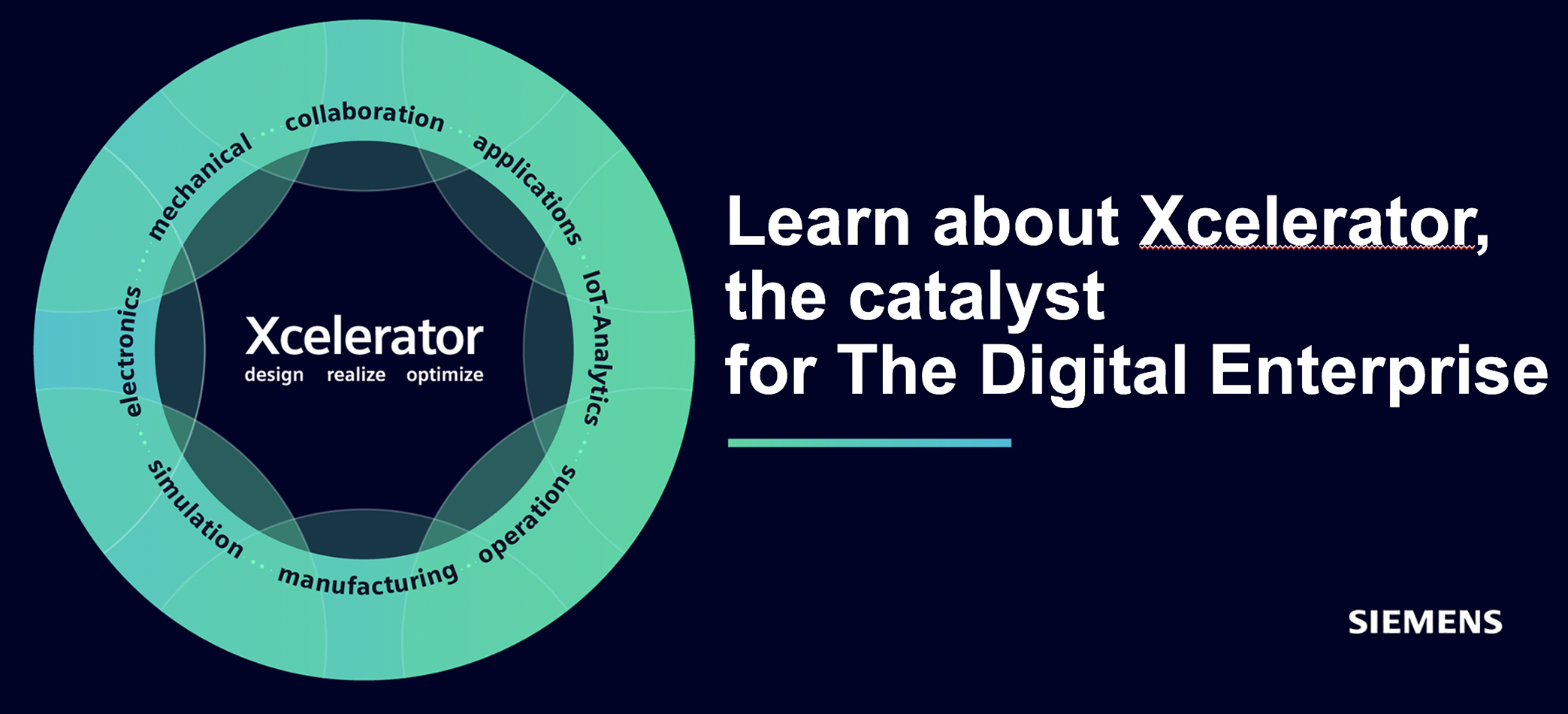
Bohman noted that the Xcelerator portfolio, with Teamcenter as the PLM backbone, has and is developing the integration, domain, and collaboration tools needed. With NX CAD (design), Simcenter (Simulation & Analysis), Capital (EDA, Electronic Design Automation, of course integrated with NX CAD for 3D wiring), Polarion (ALM, for software management, for the fastest growing product in Xcelerator portfolio) and with the SaaS and cloud platform-based series, where all solutions have the suffix X, the supporting pillars are in a “integrated digital tree.”
In short, the aim is set to develop the fully integrated backbone that modern, next generation product realization requires. The vision is even for all solutions to work under a common interface model. And they have come a long way on the journey; in a holistic perspective on product development even further than anyone else. Jones’ conclusion:
“Those who can simplify complexity and take advantage of it will become industry leaders when smart connected products, with included mechanics, electricity/electronics, and software, take over the range. In parallel, the development is towards the boundaries between concept design, detail design, and design for manufacturing beginning to dissolve. This requires innovation across all domain boundaries and an ‘integrated digital thread-backbone’. We have what it takes to build this,” added Bob Jones.

Northrop Grumman and the Integrated Digital Thread
He also noted that the giant American defense equipment giant, Northrop Grumman, has long collaborated with Siemens to develop this type of integrated digital thread:
“Yes, their NG fellow, Adam Shepherd, said during the Realize Live event in Detroit, recently, that ‘Siemens is our wingman’.
This expression is a top rating and is used in the sense that this someone provides support of crucial importance when, for example, a company solves a challenge. Generally, the meaning is that a “wingman” helps to ensure the success and safety of a project or activity. Jones continued:
“They developed this with the integrated digital thread as a backbone, for example to connect the design, engineering and manufacturing BOMs, which is a complex challenge.”
Contextually, it is also clear that the development of BOM management is one of Siemens Digital Industries Software’s strongest areas where an incredible amount of development work has been invested. From a commercial point of view, a wise investment, partly because Siemens’s perhaps most important industrial segment is automotive, where the major OEMs each produce 100,000s of BOMs every year. Every increase in efficiency, no matter how small or large, thus has a huge impact on lead time gains and time-to-market, and Jones spoke of examples where speed has been increased both tenfold and 20fold.

Scaling CAD and PDM in the X and SaaS Environment
Siemens Digital Industries Software’s EVP of global sales also gave several examples of companies that have started programs and development lines in this direction, such as Rolls Royce, Airbus, GM, and Chinese BYD (the electric car manufacturer Buy Your Dreams, which has grown explosively) on the large-scale enterprise side. Among smaller companies, Jones mentioned Vuhl Automotive and Tremonia. The former are manufacturers of lightweight, high-performance vehicles, which use Siemens software solutions to sharpen their design, engineering and manufacturing processes with tools such as NX X and Zel X, via Siemens’ cloud portfolio and technical platform solutions (SaaS/Cloud). This is while Tremonia Mobility, which develops minibuses, is now collaborating with Siemens to accelerate the electrification and development of its vehicles.
In the SMB context, Bob Jones further pointed out that Siemens’ solution offering helps to provide ”small companies with limited resources with digital capabilities that are essentially the same as those that, for example, Mercedes has access to. Not least, our investment in Designcenter X – a cloud and SaaS solution – is very important in this. We see strong growth and growth potential in that small companies can start on a smaller scale with mainstream CAD software with Designcenter Essentials (Solid Edge), and then seamlessly – within the framework of the same interface, core and built-in PDM – can then scale up to NX X as needs increase.”

Incidentally, the transformation from on-premise, local system installations, to the SaaS model and the cloud as a technical platform is going very well. The head of the PLM division, Tony Hemmelgarn, set the goal a few years ago that the recurring ARR (Annual Recurring Revenues) would increase by 40% by the end of 2025. ARR is an important metric used to assess the predictable and recurring revenues generated by a company’s subscription-based business model.
“That goal has already been achieved,” said Bob Jones. “Now the goal is to reach 50% by FY2025, and things are looking good; as of Q2, we were at 45% ARR.

More on Altair’s Role and AI Significance
But as mentioned above, AI was thematically perhaps the heaviest element in the discussions during the Siemens Realize Live event in Amsterdam. The aspects are of course many, but some of the most interesting ones were about Altair. Siemens and Altair’s complementary technical capabilities and solution structures are of great importance for the integration of the $10.6 billion acquisition’s business into the Siemens environment. But also from a purely commercial perspective, the significance of the purchase will have a significant impact on Siemens Digital Industries’ revenues. With Altair on board, Siemens Digital Industries Software can commercially consolidate Altair’s revenue is just under $666 million in 2024. The CAE and AI related, combined Siemens/Altair business will generate nearly $1.9 billion ($1.2 billion from Siemens’ existing Simulation & Analysis business), according to PLM&ERP News research and estimates, placing them in second place in the CAE market, behind Ansys at the top, which brought in $2.55 billion in 2024.
“But other things are at least as important, for example, that we are very similar culturally, which makes the merger easier,” said Jean-Claude Ercolanelli, Siemens SVP on the simulation and testing side, during the event in Amsterdam, adding that Altair has come a long way in developing AI related to the simulation pieces in virtually all product development domains.
He generally noted Altair’s strengths in nonlinear simulation, such as drop tests and explosions. Another more specific point he emphasized was SimSolid, a structural analysis software that allows engineers to simulate designs directly on complete CAD models: ”And this without having to simplify the geometry or create a mesh. This significantly reduces the time and expertise required for simulation, which enables faster design iterations. We are talking about Design-to-Simulation tools in the traditional FEA area,” he said.
From Hyperworks to the Golden Egg Rapidminer
Ercolanelli also highlighted several sharp Altair solutions that strengthen the Simcenter portfolio, such as:

- HyperWorks – which includes a set of tools for various CAE applications, including FEA (Finite Element Analysis), CFD (Computational Fluid Dynamics), multi-body dynamics, optimization, electromagnetic analysis and more.
- OptiStruct – part of the HyperWorks portfolio and an optimization solver used to analyze and optimize designs, especially with a focus on creating lighter, yet efficient designs. Often used in automotive, aerospace and other industries where performance and weight are critical.
- Last but certainly not least; the solution that several Siemens executives highlighted as a real golden egg in the Altair portfolio – RapidMiner – which the company acquired in 2022. This advanced data analytics and machine learning platform, RapidMiner pioneered the whole concept of visual, explainable data science and was the first platform to introduce automated data science, text analytics, automated feature engineering, deep learning and more. The solution has over 600,000 users in industrial manufacturing and finance, as well as an equal number in academia.
There is more, such as HPC Works and the Altair One ecosystem platform, but, as Ercolanelli said: “Together, Siemens and Altair are strengthening and democratizing solutions in terms of smart and intelligent simulation; something that is also one of the most important foundations for effective AI work.”

”AI can’t Simply be Established
with a Click of a Button”
But AI is great, you can’t just unleash AI with a click of a button or a simple installation. AI agents roaming around in giant “data lakes” doing jobs that may be based on inconsistent data, outright incorrect data, or that are working against each other are not going to make anyone happy. It’s about combining the right ones and teaching the agents to talk to each other. This requires precision, planning and sensible division of responsibilities based on overview and a sharp data backbone. Teamcenter is undeniably a strong candidate in this. Especially with connections between product development and manufacturing in smart factories. No one has gone further in this than Siemens.
Under Philomin’s leadership, the company will also drive the development of an industrial basic model that delivers industrial-quality AI for customers – designed to be safe, secure, reliable and trustworthy. This is typical of Siemens as in its approach in the Xcelerator portfolio, with the digital tools for all domain-related product development – from CAD, electrical/electronics design, material and software management to manufacturing
”Vasi Philomin has a rare combination of deep technical expertise, strategic vision and strong results in execution,” says Peter Koerte. “His outstanding expertise in AI and proven leadership in building transformative technologies will be crucial to scaling our data and AI capabilities, unlocking new opportunities within our technology stack and delivering even greater value to our customers.” In upcoming articles from the Realize Live event in Amsterdam, we will hear more from Teamcenter manager Joe Bohman and marketing director Brenda Discher. We will also present some cases, including Swedish GKN in Trollhättan, which works with Siemens Digital Industries Software’s software, and we will have a longer interview with the PLM division’s new Nordic head, Zandra Nilsson, who replaced Mats Friberg in the position as of April 1st this year.

