

Annons

Charting the Industrial Metaverse: How Siemens and HD Hyundai Are Rewriting the Shipbuilding Script

South Korean industry is a world leader in areas such as automotive, consumer electronics, and shipbuilding. Within this landscape, Siemens PLM technology in the Xcelerator portfolio has played a significant role. In 2021, for example, the company secured a major order from the world's fifth-largest car manufacturer, Hyundai KIA Motors, when the automaker decided to phase out its Dassault Systemes (CATIA) environment in favor of Siemens NX CAD and Teamcenter PLM. It was a massive order, valued by PLM&ERP News at between $250 million and $300 million.
Simultaneously, it is clear that collaborations with South Korean industry offer highly compelling commercial advantages, given that these conglomerates are closely interlinked. This applies to both the vehicle manufacturer Hyundai KIA Motors and the giant shipbuilder HD Hyundai Group. Once they recognized the benefits of Siemens' solutions, they became interested in the design intelligence Siemens could demonstrate.
Just over six months later, in June 2022, it was announced that the HD Hyundai Group decided to partner with Siemens to develop a new CAD software tailored specifically to ship design, built on Siemens NX CAD, with the goal of accelerating the group's digital transformation. Here, too, the Teamcenter PLM/PDM platform plays a crucial role in this approach.
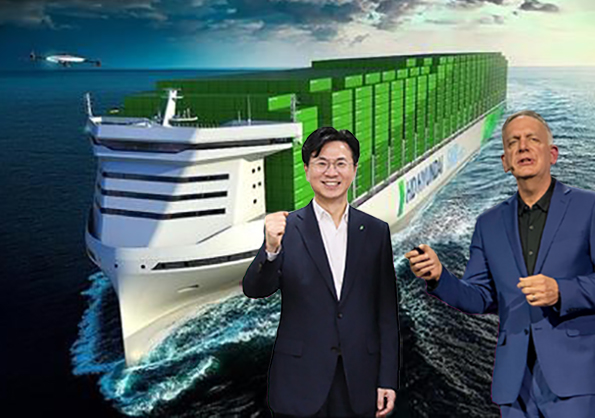
"Following our initial collaboration, we have continued to work with HD Hyundai on the development of next-generation digital design and production platforms," says Tony Hemmelgarn, President and CEO of Siemens Digital Industries Software. "With the Siemens Xcelerator platform and our comprehensive digital twin technologies, we support a unified digital thread that encompasses the entirety of design, engineering, and production."
However, changes of this magnitude—involving thousands of CAD users and tens of thousands of PLM/PDM users—cannot be implemented overnight. It is a step-by-step process that requires time. This week, Hemmelgarn and HD Hyundai Group VP Taejin Lee, Head of the Digital Innovation Office, announced that the group subsidiary HD Korea Shipbuilding & Offshore Engineering (HD KSOE) has selected Siemens as its preferred partner. The goal is to establish an integrated platform to manage the entire shipbuilding process through a single data flow, ensuring consistency across its global shipyards.
This platform will serve as the foundation for HD Hyundai’s "Future of Shipyard" project, a visionary initiative targeted for completion by 2030. The project addresses existing data discontinuities in design and production to create a more structured, digitally enabled environment. Through this integrated platform, HD Hyundai aims to strengthen collaboration between engineering and manufacturing, ensuring the stable execution of increasingly complex maritime projects.
The scope of the new platform covers various vessel types, including commercial and specialized ships. Notably, HD Hyundai intends to leverage Siemens Digital Twin Composer software to build an industrial metaverse-based environment for decision-making, collaboration, and learning.

The planned platform will thus form the basis of HD Hyundai’s ”Future of Shipyard” project, a future-oriented shipyard that aims to be completed by 2030. The project is part of HD Hyundai’s ongoing work to address data discontinuities that have existed in ship design and production processes and to establish a more structured, digitally enabled shipyard environment. Through the integrated platform, HD Hyundai aims to strengthen collaboration between engineering and manufacturing functions and to support the stable execution of increasingly complex shipyard projects.
Hyundai’s Taejin Lee says that establishing an integrated digital platform can ensure consistency from design to production:
”Exactly, we aim to address long-standing challenges with data discontinuities and create a more structured and collaborative shipyard environment. This initiative will strengthen our ability to execute increasingly complex projects while improving efficiency, quality, and competitiveness within our global shipyard operations.”
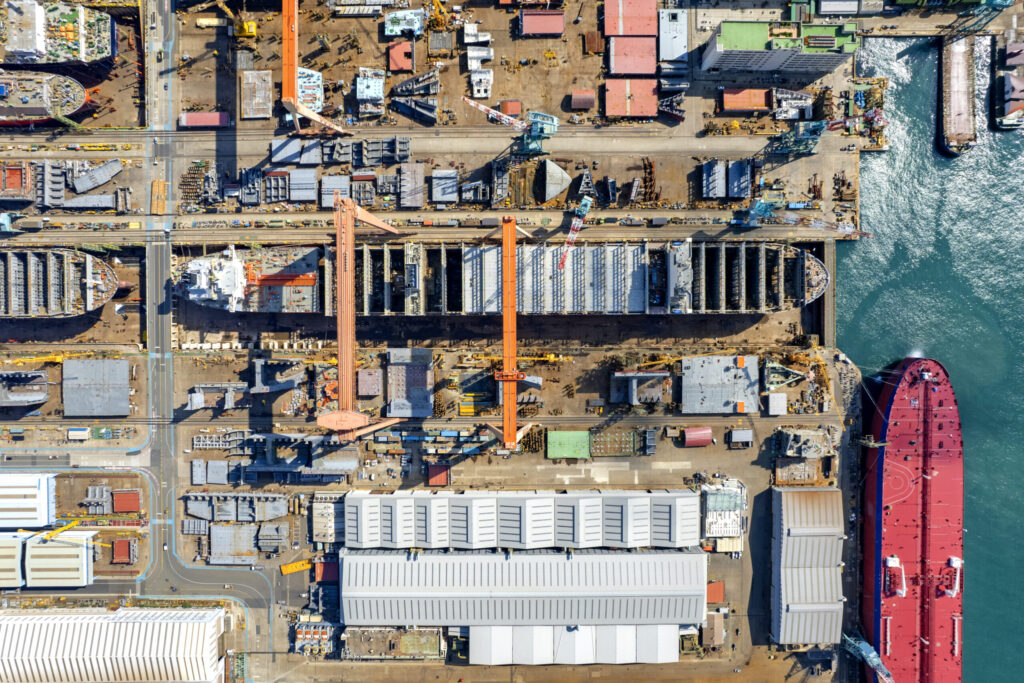
HD Hyundai Heavy Industries’ Ulsan Shipyard (image courtesy of HD Hyundai)

Unified Data Environment With Standardized Flows
Based on Siemens Xcelerator’s open digital business platform, HD Hyundai’s ”Integrated Platform for Ship Design-Production Consistency” project will also deliver a consistent digital thread of key data from design to production. Design and production will be connected in real time through a unified database, significantly reducing inefficiencies and errors caused by data gaps.

Within this unified digital environment, standardized data flows and system interoperability will connect key areas, including computer-aided design (CAD), product lifecycle management (PLM), digital manufacturing, automation, and simulation, enabling the review of major shipyard activities such as planning, construction, expansion, and modification in a virtual environment before implementation on site.

Model-Based Engineering Methods
HD Hyundai also plans to expand the application of model-based engineering methods and improve the efficiency of collaboration between organizations and functional teams. In particular, block assembly, welding information, piping, and electrical data will be managed in an integrated 3D model, improving design accuracy, optimizing production planning, and standardizing operations on the shop floor.

The scope of the integrated digital platform is expected to cover a range of ship types, including commercial vessels and specialized vessels. Key application areas include structured management of equipment and component data, digital model-based performance analysis, life-cycle-oriented maintenance technology, and technical support frameworks for overseas shipyard projects. In addition, HD Hyundai is working to build a digital representation of ships and shipyards based on Industrial Metaverse, and is implementing ”physical artificial intelligence (AI)” technology that can be used even in complex production environments by applying reinforcement learning using synthetic data and industrial intelligence in a virtual learning environment built with Siemens Digital Twin technology.

Print Friendly, PDF & Email

Success Stories

Success Stories

Industriellt

Intressant på PLM TV News

Aktuell ANALYS

Aktuell Analys

Aktuell Analys

3D-printing

Block title