


It is no small matter when Siemens Digital Industries Software holds its major user event this week—the American edition of Realize LIVE 2026, in Detroit. In front of over 3,000 users, partners, and the wider Siemens community, the leading PLM and smart manufacturing player is showcasing collective knowledge and best practices. Furthermore, the event provides a dynamic platform for Siemens to unveil its vision for the future of technology and manufacturing in a rapidly changing world.
According to Tony Hemmelgarn, the new Intelligence Center X and the platform’s AI orchestration software can make a significant impact in this regard. Driven by the platform, humans and AI agents can collaborate with shared context, workflows, and lifecycle intelligence. Using natural language queries, users can guide the tool to configure and execute tasks and workflows across Siemens’ design and manufacturing solutions.
”Intelligence Center X brings all the data together,” said Tony Hemmelgarn. ”You can begin asking questions based on that information, and it can help you determine the best path to solve a problem right in the dashboard and recommend a way forward. Then, you can ask it to go ahead and push those changes through Teamcenter. It’s definitely a shift.”
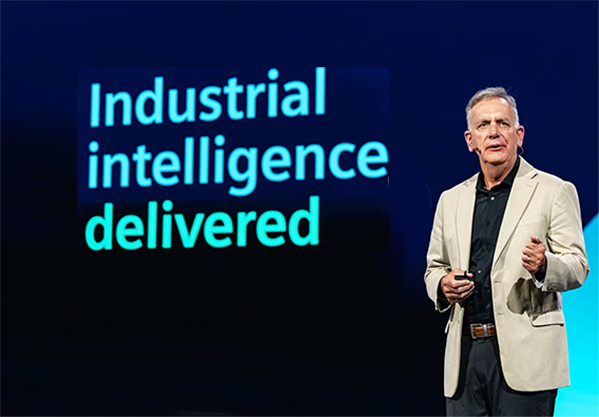
Industrial Intelligence Takes Center Stage
Hemmelgarn illustrated this shift by drawing a compelling parallel between wildfire control centers and modern manufacturing. Fire departments rely on a unified, real-time picture synthesized from weather patterns, fuel maps, satellite data, and crew locations. Similarly, manufacturers require a live view of their operations to pivot instantly when conditions disrupt even the best-laid plans.
Intelligence Center X plays a key role in this. The solution connects data from engineering, manufacturing, supply chain and service into shared lifecycle information that AI can act on. Hemmelgarn illustrated the value with an aircraft maintenance scenario. When a fleet of jets experiences unplanned downtime due to hydraulic leaks, Intelligence Center X enables the customer to build an AI agent that combines operational data with physics-based simulation to determine the root cause. Teamcenter identifies the exact configurations that are affected. Intelligence Center X then recommends whether to redesign, adjust maintenance intervals, or absorb the cost, and implement the change. From insight to decision to action.
Hemmelgarn also quoted a customer CEO: “The last thing I need in my organization is for AI to grab and lock itself into a 20-year-old SharePoint site.” Reliable results require reliable data, managed in Teamcenter, not snapshots in data lakes.

From Experiment to Real Business Impact
Zandra Nilsson, Nordic Head of Siemens Digital Industries Software, emphasizes the importance of Intelligence Center X:
“Yesterday’s announcement marks an important step in moving industrial AI from experiment to real business impact. As manufacturers face increasing complexity, productivity demands, and skills shortages, the opportunity is no longer about access to AI. It’s about connecting data, processes in the right context, and people to create measurable results at scale. Industrial AI is quickly becoming a core business rather than a future ambition,” she notes.
In a previous article on PLM&ERP News, Nilsson also stated that industrial AI must operate with reliability, security, and precision. ”These values are non-negotiable. The factories, production lines, and technical workflows that underpin our industry must not be compromised. We are integrating this—what we call technical AI—across our entire portfolio. It ranges from intelligent copilots that empower engineers, to predictive maintenance systems that ensure uptime, to generative AI that accelerates design exploration. It’s about equipping Nordic industry with the tools to remain competitive. By linking our knowledge and footprint, we are also enabling an AI fabric, which uses a semantic layer to connect silo-based data and build agent-based AI on top.”
AI that Enhances Engineering
Returning to Tony Hemmelgarn: what were the three composite layers of Siemens’ AI strategy discussed in the introduction?
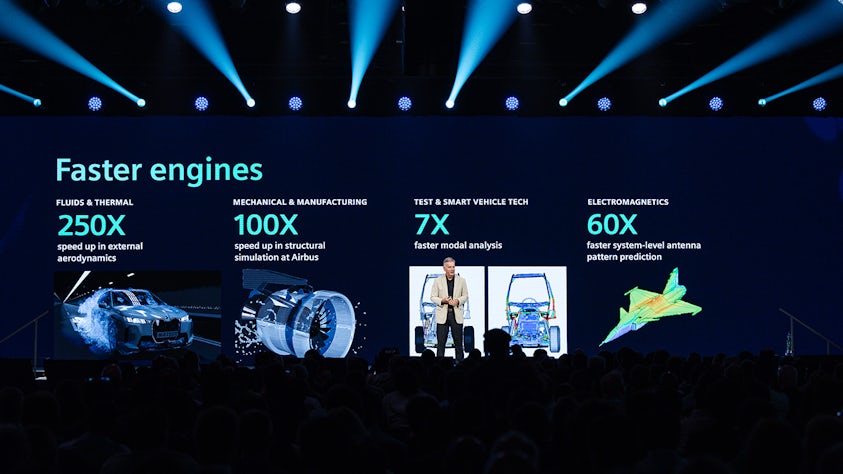
- Faster engines leverage AI to narrow the design space, learning from past simulations and real-world data to focus computation where it matters most. “The physics engine doesn’t change. What changes is how intelligently we direct it. It doesn’t replace deterministic truth; it makes it scalable,” Hemmelgarn noted.
- Smarter execution embeds intelligence directly into workflows, automating routines and amplifying expertise across design, simulation, and operations.
- Reliable results transform lifecycle data into actionable intelligence, ensuring the right architecture, the right trade-offs, and the right decisions.
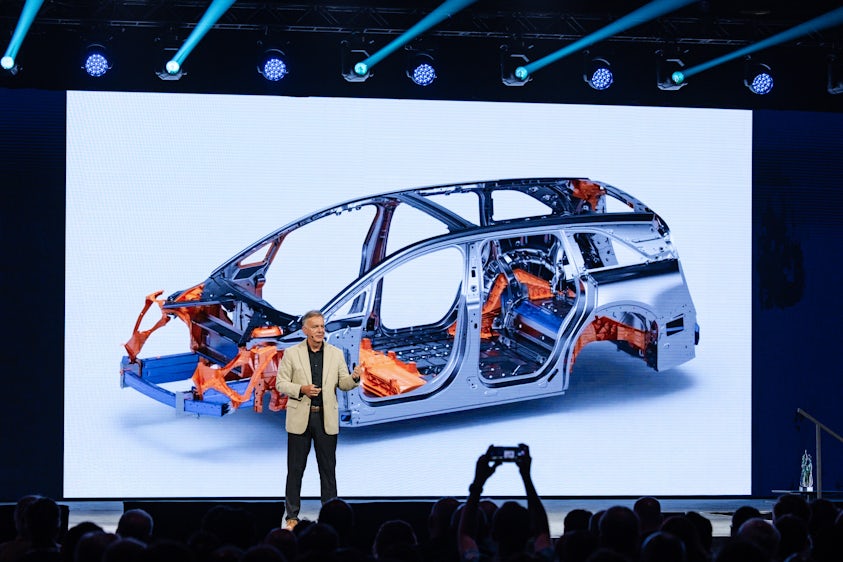
Simcenter Simsolid, PhysicsAI and GenAI for Design
Simcenter Simsolid eliminates one of the biggest bottlenecks in simulation—the geometry preparation and meshing process—taking engineers from CAD assemblies to analysis in minutes. From Airbus and Rolls-Royce to hundreds of small and medium-sized enterprises, customers worldwide have adopted the software for the speed and accuracy it delivers.
Building on this foundation Simcenter PhysicsAI Generate was annlounced. This tool generates new design concepts from input and output geometry, which engineers can edit directly using Siemens’ Convergent Modeling technology. The result? Simulation-quality insights and fresh design concepts, all in a matter of seconds.
In short, the solution leverages artificial intelligence to help engineers explore options and discover the best solutions quickly. By delivering unmatched speed and intelligence, Simcenter PhysicsAI frees teams from repetitive tasks and fragmented data. Ultimately, this allows engineers to focus on what truly matters: driving creativity and accelerating innovation.
Simcenter PhysicsAI empowers engineers to reuse existing CFD results as GDL training data, slashing the time required to build predictive models. By training and validating AI surrogate models on historical simulations, teams can generate near-instant predictions.
Bridging PLM and EDA for the 3D IC Era
Electronics (and electricity) represent one of the most critical sectors in modern product development—a fact underscored by Siemens, where just over a third of PLM revenue originates from this domain.
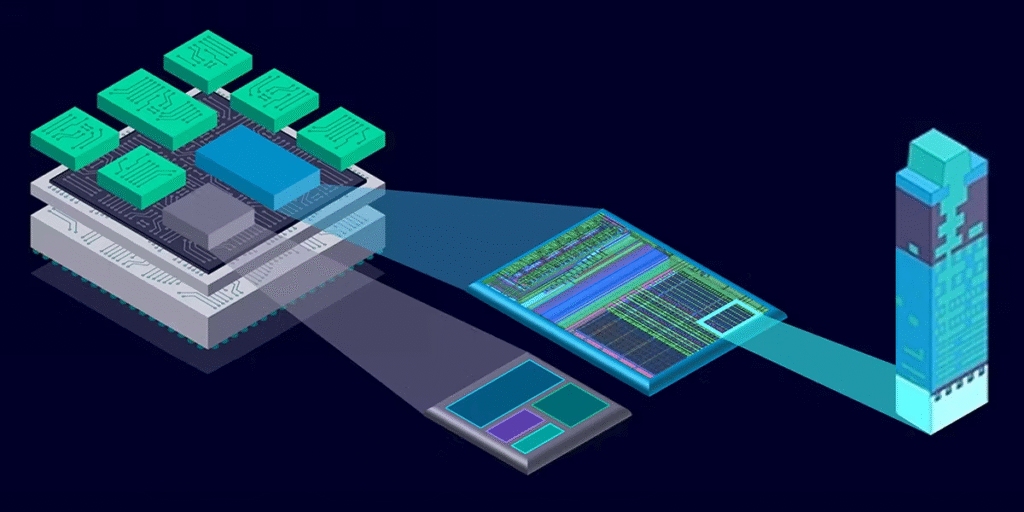
As Moore’s Law reaches physical limits and AI demands faster integrated circuits, the industry is transitioning to 3D IC stacking, where thermal, electrical, and mechanical forces collide. Siemens’ integration of PLM and EDA is paying dividends here through a robust toolset: Simcenter for thermal flow, Innovator3D IC for stacked die architectures, Calibre 3DThermal for die-level hotspots, and AI-driven analysis for the entire stack. The ultimate goal is to engineer reliability upfront, rather than discovering flaws in the field, where yield losses can reach 50 percent.
Design-to-Source Intelligence
Siemens is expanding real-time market intelligence beyond electronics. Siemens Supplyframe already serves 15 million users with pricing, availability, and lifecycle data. The new Xometry partnership, featuring deep Designcenter integration, extends this intelligence to CNC machining, 3D printing, metal fabrication, and injection molding. Meanwhile, the Volition acquisition adds standardized industrial parts from thousands of suppliers to the ecosystem.
“When you design, you can see exactly what this thing costs. And with the click of a button, you can get it manufactured,” Hemmelgarn said. “Design-to-cost-to-sourcing—it all happens in seconds.”
Software-Defined Products
For products with millions of lines of code, Hemmelgarn argued that testing is a systems problem, not just a software problem. Siemens’ technology connects silicon, electronics, mechanics, manufacturing, and operations into a complete digital twin for enterprise-scale verification. In one demonstration, product software was validated against a virtual ARM processor that has yet to be built. This approach then accelerates root cause analysis and catches hardware and software issues the moment they arise, rather than months later in the lab.
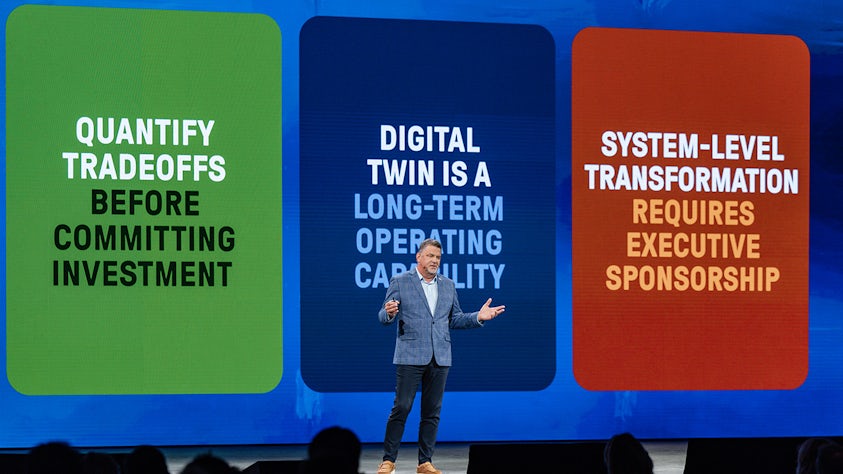
PepsiCo: On Winning with a Complete Digital Twin
Following Hemmelgarn’s overview, Steve Hoinka, global VP of manufacturing strategy and transformation at PepsiCo, shared how the company is using the digital twin to reimagine manufacturing and warehousing operations without expanding its physical footprint.
When you think of PepsiCo, you probably think of soda and snacks. I’m willing to bet that in 15 minutes, you won’t be able to hear the company name without thinking of AI-driven transformation.
The challenge Hoinka described was to merge two former facilities, channel products to a new blending center, and free up new capacity. Using Teamcenter, Plant Simulation, and Digital Twin Composer, accelerated by NVIDIA Omniverse, PepsiCo built a complete digital twin of its entire value chain and ran multiple design iterations in weeks rather than months.
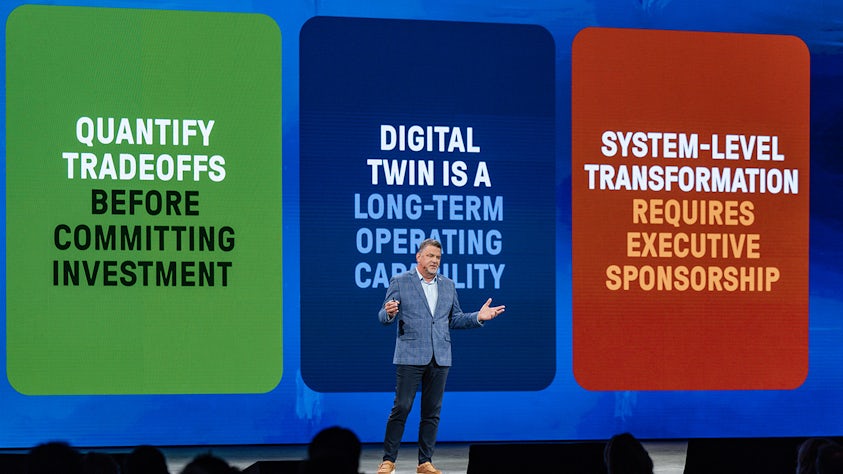
”We make no moves and commit to zero capital investments unless we validate it digitally first. Design digitally, deploy physically,” said Steve Hoinka.
The results:
- 90+ percent of potential operational issues avoided before implementation
- 20 percent improvement in throughput across the value chain
- 10–15 percent reduction in capital costs through digitally focused design
- Design cycles compressed from months to weeks
“This started as a grassroots effort. It became an enterprise-wide transformation because leadership saw the results and said, ‘We need this everywhere.’ When your CEO drives the conversation, the speed at which things move changes.” The collaboration between PepsiCo, Siemens, and NVIDIA, announced at CES 2026, is already scaling to additional facilities globally. “A digital twin is not a project. It is a new way of life. Think big. Start small. Invest quickly. And that, my friends, is how PepsiCo and Siemens win with partnership,” concluded Hoinka.
About Hemmelgarn’s Role as a Leading Visionary
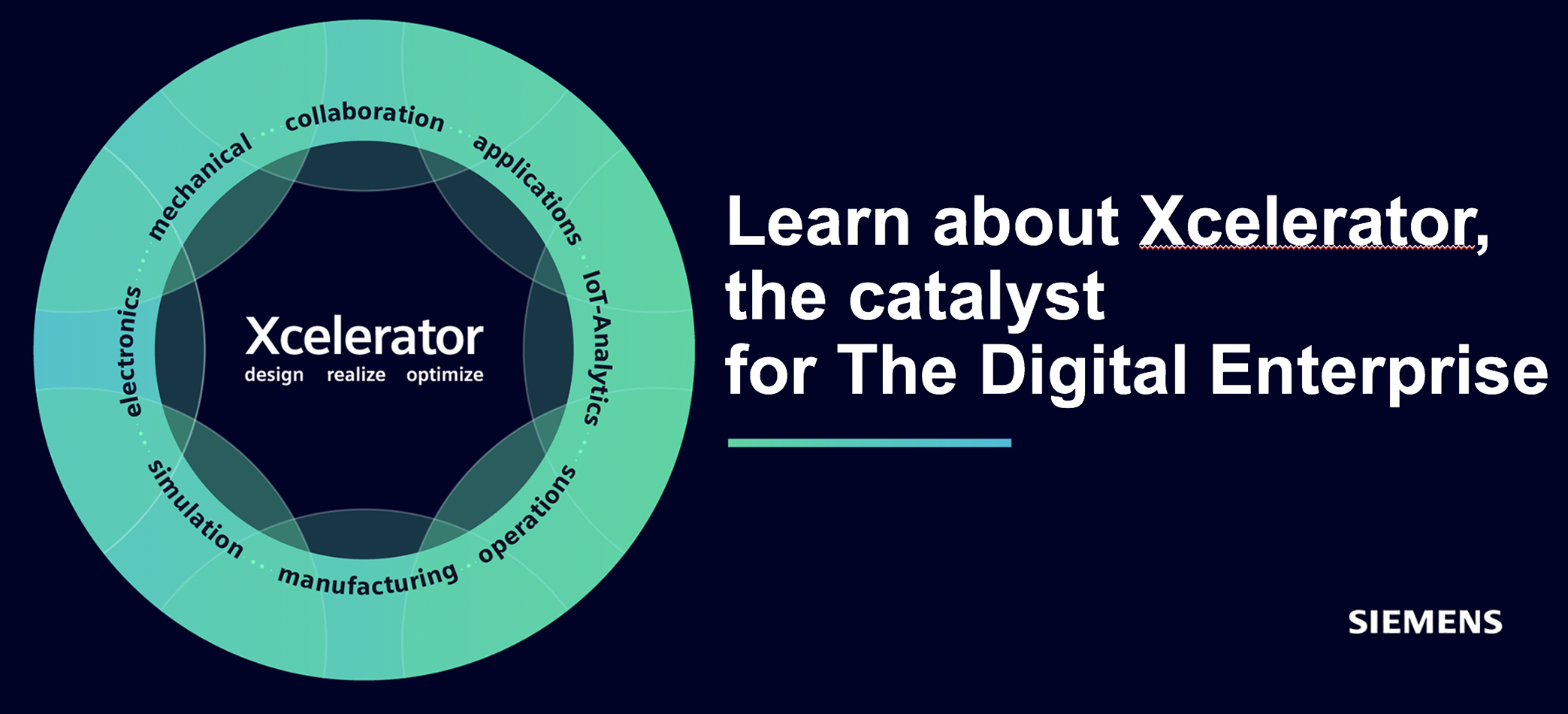
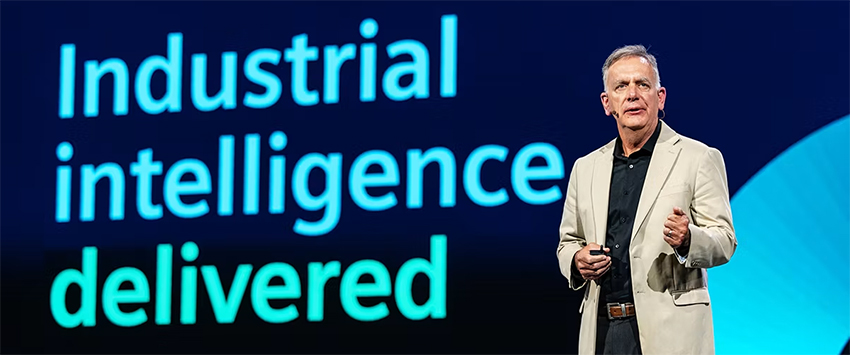
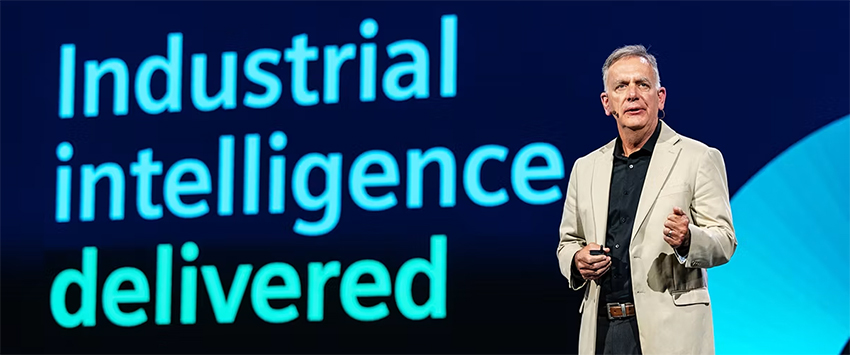
Since taking the helm as CEO of Siemens’ PLM division in October 2016, Tony Hemmelgarn has cemented his status as one of the industry’s most influential leaders. This reputation has been heavily driven by Siemens’ aggressive development and integration of AI—including generative AI and smart agents—into its software portfolio, Xcelertator, in recent years.
Hemmelgarn has been a driving force behind major strategic moves. Chief among these are major investments in EDA (Electronic Design Automation), which now accounts for a third of the PLM division’s revenue; the landmark acquisition of Altair; and the recent rollout of the Intelligence Center X cloud orchestration platform and AI-powered digital twins.
In light of these initiatives, Hemmelgarn’s proactive leadership and forward-thinking vision have made him a pace-setter in the PLM space. Through this, he has effectively assumed the mantle of the industry’s previous top visionary: long-time Dassault Systèmes leader, Bernard Charlès.
However there are interesting differencies:
Both of these leaders have pioneered concepts rooted in a broad, holistic vision. They favor modular platforms where capabilities integrate seamlessly to support an expanding array of product development processes. Consequently, their corporate acquisitions have focused on securing components for a complete system rather than standalone software.
The primary divergence in their strategies is that Siemens, guided by leaders like Tony Hemmelgarn, has invested heavily in an open, seamless ecosystem. This approach does not mandate the use of proprietary software; instead, it relies heavily on industry-standard platforms, such as Parasolid’s core technology. In contrast, Dassault Systèmes (DS) has maintained a more proprietary approach, relying on its own software to achieve seamless integration.
Another key difference lies in each organization’s capacity to execute its stated visions. Here, Siemens has demonstrated greater efficiency, whereas DS has historically taken longer to roll out Brrnard’s visionary, corresponding solutions.
Finally, a major differentiator is Siemens’ integration with manufacturing automation on the shop floor. As a long-standing industry leader in both hardware and software, Siemens successfully bridges the gap between PLM and shop-floor execution. Furthermore, the company leverages its own manufacturing operations to iteratively develop and test these solutions.
Overall, this has made a difference and is a strong reason for Siemens’ leading position in global product realization.

