




The Anatomy of a Decision:
Why Material Selection Makes or Breaks a Product
Material choice is one of the most critical turning points in product development. Locked in during the earliest stages of the engineering design process, it ultimately dictates a product’s real-world performance, bottom-line cost, regulatory compliance, and environmental footprint. In practice, these parameters are fundamentally fixed long before a single unit ever rolls off the production line.
Yet, fatal flaws in material specification are frequently uncovered far too late in the cycle—at a stage where rectifying them requires prohibitively expensive redesigns or causes severe time-to-market delays.

A Crucial Priority in Compliance
Navigating compliance is particularly critical. EU chemical regulations like REACH and the RoHS directive impose strict limits on hazardous substances, and in Sweden, these are augmented by the Swedish Chemicals Agency’s regulations. If a compliance deviation is detected late in the process, the product can no longer be sold, and the entire development cycle must begin anew. As Anne-Laure Chabrillat points out, having access to reliable material data early in the process is essential to mitigating these risks.
”If you discover at the end of the development phase that a material in your design doesn’t meet regulatory standards, you can’t sell the product. You are forced to go back to the drawing board and start over. Accessing that information early on prevents those costly mistakes,” says Chabrillat.

The same logic applies to sustainability goals, even if the consequences feel less immediate. Yet here too, regulatory pressure is mounting. Under the EU Taxonomy regulation, which defines which economic activities qualify as environmentally sustainable, Swedish companies seeking green financing or looking to attract ESG-minded investors can no longer rely on promises—they must prove their climate performance with hard data. Financial analysts are increasingly scrutinizing whether businesses will rely on carbon credits to offset emissions, knowing that the higher the credit count, the lower the profitability.
A Source of Truth from the Drawing Board
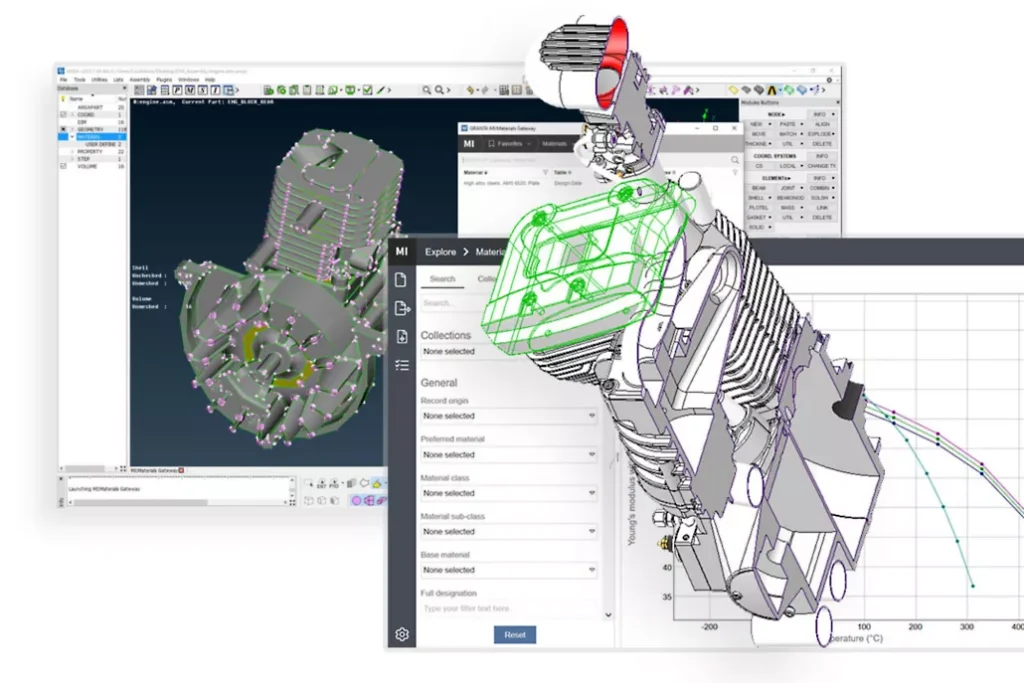
Ansys Granta is built on the foundation of a single, authoritative source of truth for all corporate material data. Materials experts validate and provision this data within a centralized database. Instead of relying on local datasets or rough estimates, designers can simply select materials directly from this database while working within their native design tools.
Once a material is assigned to a component, its sustainability metrics, regulatory compliance status, and technical properties are automatically inherited.
The system facilitates early trade-offs in the design phase—precisely when modifications remain highly cost-effective to execute. Ansys Granta integrates with a vast spectrum of tools. Within the proprietary Ansys ecosystem, seamless connections exist for Workbench, Electronics Desktop, Discovery, and Minerva, while the optimization engine optiSLang boasts a dedicated interface to Granta.
On the CAD and PLM front, the platform supports PTC Creo and Windchill, as well as Siemens NX, Simcenter 3D, and Teamcenter. Furthermore, out-of-the-box integrations are provided for industry-standard solvers like Altair HyperMesh, Beta CAE ANSA, and Dassault Systèmes Abaqus.
For teams looking to custom-build their own engineering workflows, access is available through Python using PyGranta or directly via the MI Server API. This ensures that critical material data can be seamlessly fed into virtually any design or simulation workflow without engineers ever needing to leave the environments they are already working in.
By leveraging the existing product structure in the company’s chosen PLM system, the overall environmental footprint of an entire product can be calculated automatically. Engineers can compare diverse material selections in a matter of seconds, gaining immediate insights into how these choices impact both mechanical performance and their carbon footprint.
”Imagine an engineer working on a simulation model, aiming to balance mechanical strength and thermal stability with a minimal carbon footprint. We can provide clear indicators: if you swap one material for another, you can perhaps cut the carbon footprint from raw material extraction by ten percent. This empowers the engineer to make the right data-driven decisions,” explains Mickaël Capelli.
Built-in traceability is a game-changer. When engineers share models through their PLM system, the entire team can trust that every material ties back to a single source with one consistent set of properties. This eliminates one of the most common bottlenecks in manufacturing quality—different departments working with conflicting versions of material data.

CSRD Tightens the Reins Across the Entire Value Chain
The EU’s Corporate Sustainability Reporting Directive (CSRD) is rolling out in phases, forcing manufacturers to face increasingly stringent demands. Companies must now disclose their environmental footprint across the entire value chain. This includes Scope 3 emissions—those tied directly to raw materials and suppliers rather than the company’s internal operations. For enterprises managing complex product portfolios and vast numbers of product variants, this exercise proves exceptionally daunting without automated systems.
Chabrillat shared a telling anecdote: a major manufacturing company recently hired an external consultant to conduct an environmental impact assessment on just a single product. The process dragged on for six months.
”The consultant told them straight out: ’You need an automated way to capture this data. There are so many variations in your catalog that I cannot spend six months on each one. You need a system in place,'” Chabrillat recalls.
Ansys Granta addresses this by allowing companies to generate life cycle assessments (LCAs), comprehensive material declarations, and digital product passports directly from existing product data in PTC Windchill.

It is also worth noting that CSRD requirements apply to non-EU companies wishing to sell within the European market. If your goal is to sell in the EU, compliance is mandatory—regardless of where your business is globally headquartered.
From Weeks to Seconds: A Real-World Case Study
An electrical infrastructure manufacturer provides a tangible example of what happens when material intelligence is systematized. The company implemented Ansys Granta in tandem with Windchill PLM approximately a year ago and has demonstrated measurable results ever since.
”They have conducted a comprehensive review of their components against key EU regulations—REACH and RoHS—with remarkable ease. By pulling data directly from their bills of materials in Windchill, generating a complete compliance assessment now takes just a few clicks. They went from weeks to seconds,” explains Capelli.
This reclaimed time has allowed the company to redirect its focus toward a strategically vital initiative: actively sourcing alternative materials with superior sustainability profiles. According to Chabrillat and Capelli, this is a recurring pattern in the industry; companies that automate fundamental compliance free up the capacity to handle sustainability proactively rather than reactively.

The Human Element: Breaking Through the Digitalization Barrier
When asked what typically stalls companies from launching data-driven sustainability initiatives, Chabrillat answered without hesitation: the hurdle is not technical.
”The biggest obstacle is convincing executive leadership that this is a priority, and that it needs a dedicated spot on their corporate roadmap,” she said. ”That is the single greatest barrier I see.”
This perspective echoed a broader theme throughout PDSFORUM: the true challenge of any digitalization journey lies in organizational transformation, not software. During the event, PDSVISION CEO Aleksander Patz Cholakov highlighted that many businesses remain stuck in status quo—not due to a lack of tools, but because they lack the governance and internal capacity to drive meaningful change.
For sustainability initiatives, there is an additional, powerful lever to win over the C-suite: the financial bottom line. Financial analysts are increasingly scrutinizing whether companies will have to purchase carbon credits to offset their emissions down the line. Consequently, organizations that proactively build the capacity to design for a lower carbon footprint right from the start will secure a distinct competitive edge.

Get a head start before it becomes a mandate
Capelli concluded with advice directed at companies that have yet to embark on this journey: ”We are well aware of how crucial sustainability is, and how it will become increasingly important and heavily mandated by legislation. What we want to do is help companies stay ahead of the curve before it hits them and risks becoming a liability. Start early, both in the design process and in the work of structuring your material data,” Capelli states.
It is a message that fits perfectly into the broader dialogue held at PDSFORUM: companies that build a structured data platform today are laying the groundwork for both AI and sustainability reporting tomorrow. Technical debt must be managed first. And when it comes to material data, you need to start right at the drawing board.
Inside Ansys Granta and PDSVISION
Ansys Granta is a premier material intelligence solution designed to help manufacturers streamline material data, sustainability metrics, and regulatory compliance within a unified platform. By integrating seamlessly with PTC Creo and Windchill, the system embeds critical material insights directly into the design workflow. This empowers engineering teams to effortlessly meet lifecycle assessment (LCA) demands, full material declarations (FMD), and the European Union’s upcoming Digital Product Passport (DPP) requirements.
A prime example of this synergy in action features a prominent electrical infrastructure manufacturer using Granta alongside Windchill. Following implementation, the company successfully slashed its regulatory compliance assessment time from weeks to mere seconds.
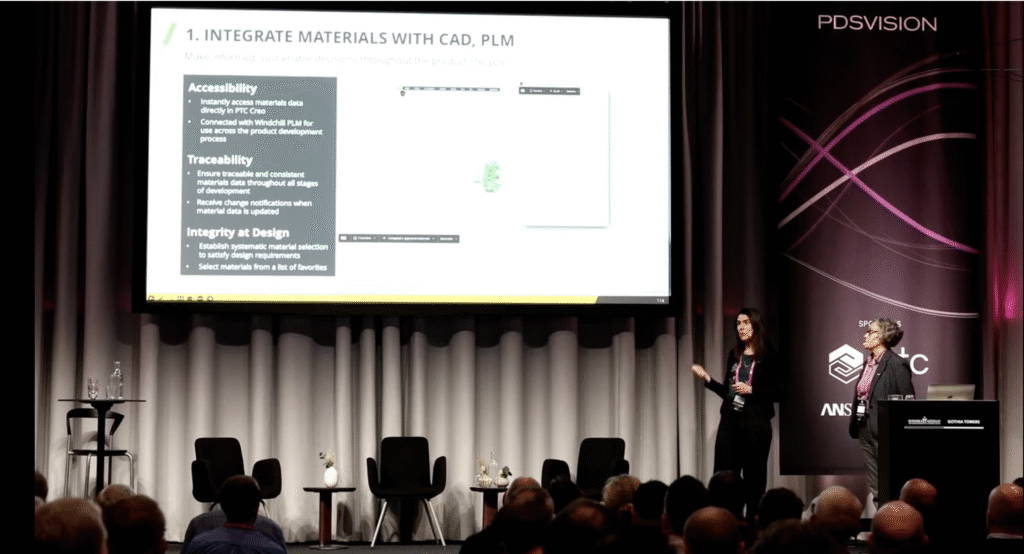
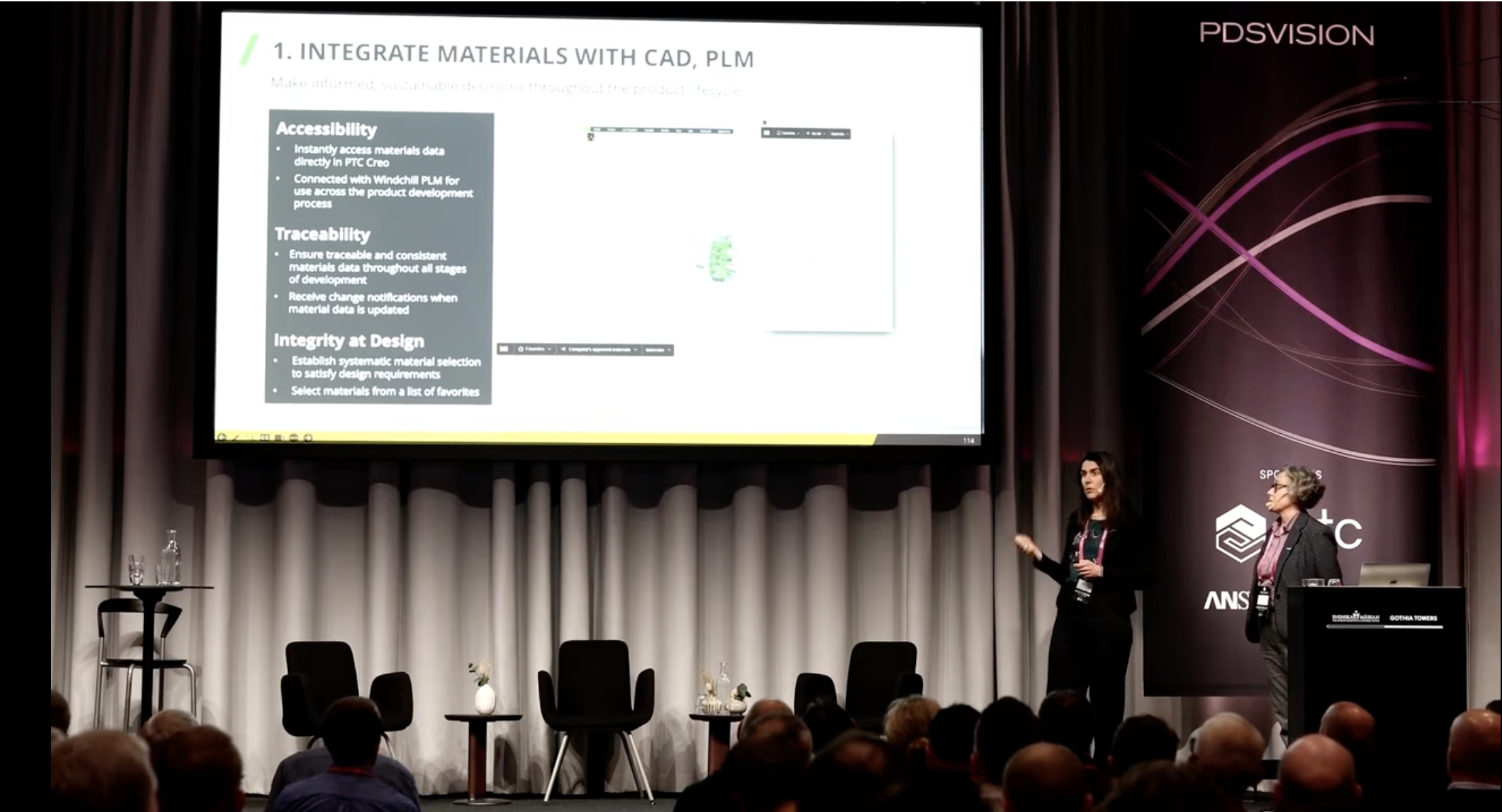
PDSVISION is a leading Nordic partner for both PTC and Ansys ecosystems. Demonstrating this expertise, Anne-Laure Chabrillat and Mickaël Capelli recently presented at PDSFORUM in Gothenburg in May 2026.

