


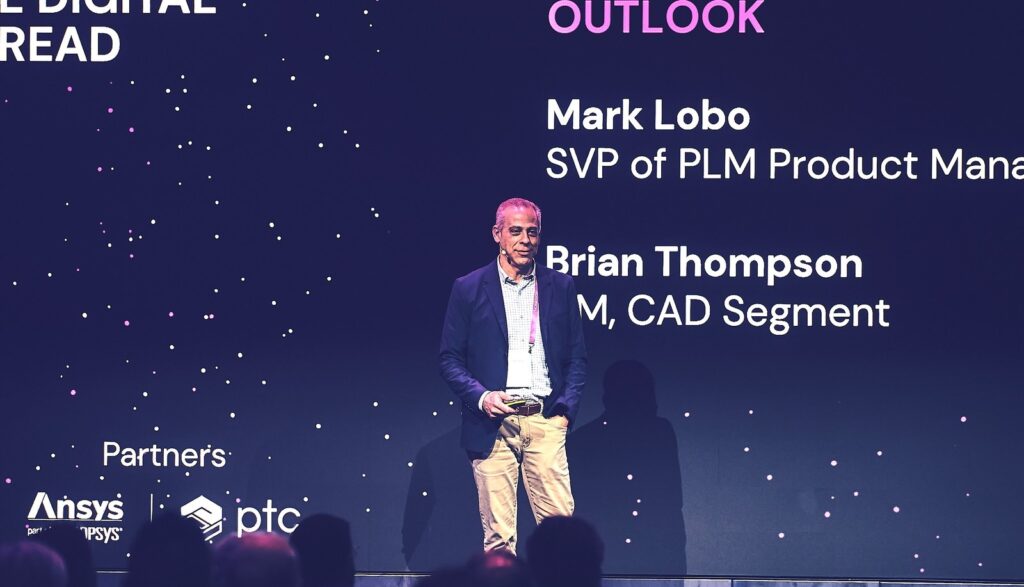
As General Manager of PTC’s most advanced CAD solution, Creo (the high-end platform formerly known as Pro/ENGINEER), Brian Thompson is a driving force behind the company’s product strategy. He has helmed the Creo business for eleven years.
Notably, PTC’s broader CAD portfolio also features Onshape, a completely browser-based, cloud-native SaaS platform that allows multiple users to design and collaborate in real time. Thompson’s focus, however, is entirely on Creo.
What are the tangible business benefits for manufacturing companies adopting an integrated CAD and PLM ecosystem?
”It’s really about two things. First, speed: because Creo and Windchill manage the relationships between data, a change in one place is automatically propagated everywhere. With fragmented tools, you can still push changes through, but that requires manual intervention. Second, it’s about reliability and quality. There’s no data translation involved, which is crucial, because whenever you derive data from outside the system, there is always a risk of error. With everything integrated into Windchill, nothing falls through the cracks because the data never actually leaves the system.”
Hype With Notable Exceptions
All credit to the interviewer, but it is only when we reach the subject of AI that the conversation truly hits its stride. The role of AI is a topic on which everyone in the industry has an opinion, but few dare to give a straightforward answer. Thompson, however, is not afraid to face reality—a reality where successfully implementing AI and achieving desired results remains rare. According to analysts, the failure rate in delivering expected technical value has hovered between 80–85%. Furthermore, MIT studies have highlighted that a vast majority of generative AI pilot projects fail to generate measurable ROIs. At the same time, Gartner recently predicted that 60% of all AI projects lacking the proper data structure will be abandoned.
The outlook appears challenging, making it easy to understand why Brian Thompson believes there is still a long way to go. Yet, this does not negate the fact that tangible, high-value AI solutions already exist today. Notable systems, such as those from PTC, are proving capable of delivering a remarkably high return.
Where is AI making the biggest difference in product development today, and where is it simply hype?
”Right now, much of it is hype,” says Thompson. ”However, there are exciting features that are genuinely delivering value by providing engineers with contextually relevant guidance—right in their workflow. AI doesn’t replace what Creo can do; rather, it highlights how the software can assist users with their specific tasks in ways that would otherwise require extensive research. It’s a massive boost to both user productivity and the overall quality of the engineering output.”
A Three-Tiered AI Strategy
It is worth placing Thompson’s insights into a broader context. At PDSFORUM, PTC outlined a three-tiered AI strategy:
- Advisory AI: Answers specific questions about product data.
- Assistant AI: Actively supports and optimizes engineering workflows.
- Autonomous AI: Executes design changes under direct engineer supervision.

Thompson said on stage that about 35 percent of the AI PTC showcased at the event would be in production by 2026. However, in a one-on-one conversation, the nuances became clearer.
How do you keep Creo and Windchill relevant as AI and cloud services change the playing field?
“What makes Creo and Windchill truly strong is very difficult to replicate with AI. Our strategy is to amplify the power of these systems with AI, and it works well. There are a lot of simpler software programs where AI feels more directly applicable. But a Creo geometry is something else.”
What is PTC’s top priority over the next two years?
“It’s hard to overstate how important it is for us to stitch together the entire portfolio in the same way that Creo and Windchill are already integrated. The reason is not only that it’s valuable in itself, but because in the AI era, it provides the opportunity for AI to coordinate tasks across the entire portfolio. We want to make sure that AI understands how the tools are supposed to work together. I think that will fundamentally change things.”
The Market: Open Strategy in a Locked-Down Segment
The advanced CAD market is one of the most consolidated in the technology industry. Dassault Systèmes’ CATIA has long held the market leader position, with Siemens NX and PTC’s Creo serving as formidable challengers. Replacing platforms in an organization with thousands of engineers is rarely a middle-management decision; it quickly escalates to the boardroom. Consequently, market shares have stagnated.
How do you view your market position, and where are you heading?
“We are quite pleased with our competitive standing. We aren’t number one in our markets, and that’s not something I want to debate. However, we have strong momentum moving forward. Our open strategy has actually helped us win business from customers primarily using competitors’ solutions, and we are thrilled with that. We want to compete and win on our own merits, not by locking others out of our ecosystem,” Thompson said, adding that: ”It is a line of reasoning that becomes easier to follow when Windchill functions as the unifying PLM platform.”
Thompson helps illustrate:
“A customer might have Creo engineers in one part of the organization and CATIA engineers in another, yet still rely on Windchill as their common PLM network. This gives PTC a foothold where competitors might otherwise block them out.”

A Crowded Field: Navigating the High-Stakes CAD Competition
Competition in the advanced CAD segment is fierce, with Dassault CATIA acting as the market leader and Creo serving as a strong challenger alongside Siemens NX.
How do you see the development?
What is affecting market share, and what role does AI play?
“The premise of the question is correct—it’s a tough market,” Thompson says. “The decision to switch from one advanced tool to another in a large industrial company with thousands of engineers quickly becomes a top-level decision, so these changes don’t happen very often.”
But Thompson identifies two major factors that could change the picture.
“There is a clear movement toward the cloud and software-as-a-service (SaaS). Customers want to spend less time and energy managing their advanced systems. They want it as a service, but at a reasonable price. That’s a big driver. Then we have AI. I think the company among the big three that really manages to deliver value—both in the cloud and with AI—can gain significant ground on the others. But time will tell, because you don’t rip a CAD system out of the hands of five thousand engineers without a compelling business reason.”
He continues with an observation typical of his pragmatic tone:
“I see more movement in the supply chain of large companies than at the top level of the manufacturers themselves. It is there, among the hundreds of engineers in the company’s supply chain seeking productivity gains, that changes take place most easily.”
EU Regulations and Sustainability as Differentiating Drivers
”How do you see the Nordic and European manufacturing industry? What are the challenges and opportunities compared to other markets?”
”There are two themes here that I don’t see as strongly in, for example, North America. One is sustainability, which is still driving a lot of conversations. The other is the regulatory requirements that come with the Nordics being part of the EU, and thus facing strong legislative influence on how to develop and deliver products to the market. We see these as major drivers, perhaps more than we do in North America or Asia. But when I talk to a design manager from one of our customers here, their main goal is just to get the most out of their engineers—just like everyone else,” concludes Brian Thompson.

