




During the recent CES event in Las Vegas Siemens and NVIDIA announced a significant expansion of their strategic partnership to bring artificial intelligence into the real world. Together, the companies aim to develop industrial and physical AI solutions that will bring AI-driven innovation to every industry and industrial workflow, as well as accelerate each others’ operations.
To support development, NVIDIA will provide AI infrastructure, simulation libraries, models, frameworks, and blueprints, while Siemens will commit leading software, hardware, and hundreds of industrial AI experts.
Siemens AG boss, CEO and President Roland Busch, was very enthusiastic on the CES stage and spoke of a paradigm shift:
”Siemens’ keynote marked a new era of technology for industry and infrastructure,” he said adding that, ”With AI-enabled technologies, deep domain expertise, and trusted partnerships, we are converting this technological leap into measurable benefits for customers, partners, and society.”

He went on claiming that industrial AI is no longer a feature; ”it’s a force that will reshape the next century. Siemens is delivering AI-native capabilities, intelligence embedded end-to-end across design, engineering and operations, to help our customers anticipate issues, accelerate innovation and reduce cost,” asserted Busch.
Moreover, he pointed out that just as electricity once revolutionized the world, industry is shifting toward elements where AI powers products, factories, buildings, grids and transportation. “From the most comprehensive digital twin and AI-powered hardware to copilots on the shop floor, we’re scaling intelligence across the physical world, so businesses realize speed, quality and efficiency all at once. This is how we scale a once-in-a-generation technology shift into measurable outcomes.”

The Digital Twin Composer – From Passive Simulation to Active Intelligence
So, what do the respective company roles look like in this process?
Clearly, the new Digital Twin Composer plays a key role, to power AI and the industrial metaverse at scale:
”Yes, it does,” said Joe Bohman, EVP, PLM Products, Siemens Digital Industries Software, when it was launched during CES 2026 in Las Vegas. ”Many design, engineering, and production teams still work independently, each relying on different tools and disconnected data systems. Digital Twin Composer reduces these barriers by unifying design, simulation, and operations into one living and contextualized model that empowers engineers to test products, processes, and facilities in minutes, validate automation long before hardware exists, and operate the real product or facility from one digital twin.”
Moreover, Bohman added that the new Digital Twin Composer, ”delivers on our vision for the industrial metaverse. It helps manufacturers to overcome the unprecedented challenges of mastering complexity, accelerating production, reducing costs, and increasing profitability. Siemens and NVIDIA are partnering to help manufacturers bring the most complex products, processes, and factories online faster, boost resiliency and sustainability, and continuously optimize performance.”
Rev Lebaredian, VP of Omniverse and Simulation Technology, NVIDIA, also explained that, ”By integrating NVIDIA Omniverse libraries into Digital Twin Composer, enterprises can take advantage of physically accurate simulation across their workflows to validate their entire lifecycle – from product design to factory logistics – in the virtual world before committing a single atom to the real one.”
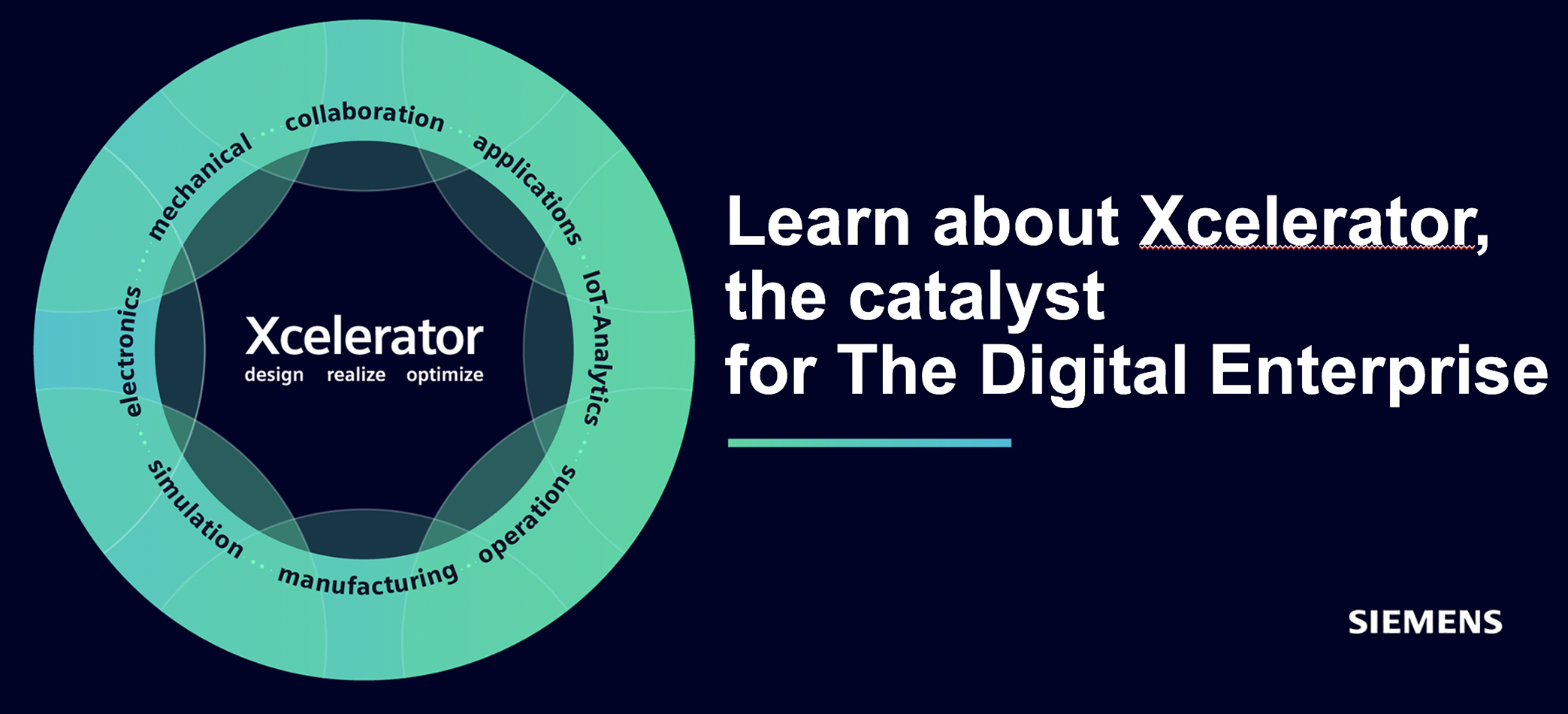
Digital Twin Composer is part of Siemens Xcelerator, and establishes a digital thread that connects the silos of design, engineering, and operations across the Siemens Xcelerator ecosystem.
”Digital Twin Composer is used to connect the high performance, photorealistic and physically accurate 3D digital twin created using Siemens Xcelerator to real-world physical data sources as such manufacturing execution software (MES), quality management systems (QMS), programmable logic controller (PLC) code from a machine or factory asset or industrial internet of things (IIoT) data – from across an open ecosystem of engineering data.”

Siemens Xcelerator – a Data Backbone
That said, it is notable that Siemens’ role in the ambition to create the new AI-based industrial operating system is also distinguished by the following components:
• Siemens Xcelerator: This open digital business platform serves as the data backbone, connecting mechanical, electrical/electronics, and software domains. Examples of software are NX (CAD), Simcenter (CAE platform), Xpedition (EDA/PCB design flagship), Polarion (ALM), and more
• Industrial Hardware: Providing GPU-certified industrial PCs and advanced factory automation controllers designed for harsh environments.
• Physical Infrastructure: Managing power, cooling, electrification, and grid integration to support high-density AI data centers and factories.
• AI-Powered Copilots: Deploying a suite of nine industrial copilots across its software portfolio (e.g., Teamcenter, Opcenter) to assist workers with complex tasks. These copilots will embed intelligence that extends from design and simulation to product lifecycle management, manufacturing, and operations. The new AI-powered copilots for its software offerings will include Teamcenter, Polarion, and Opcenter. These copilots, respectively, streamline product data navigation, reducing errors and accelerating time to market; automate compliance, helping to ensure faster regulatory approvals and lower risk; and transform manufacturing processes, driving cost savings and operational efficiency.
Along with the rest of Siemens’ expanding portfolio of industrial AI solutions, the pilots are available to companies of every size on the Siemens Xcelerator Marketplace.

NVIDIA – Not Just a Chip Designer, but a Full Stack AI Provider
NVIDIA’s main point, as articulated by CEO Jensen Huang and reflected in its 2026 business strategy, is that the world has shifted from general-purpose computing to accelerated computing. The company positions itself not just as a chip designer, but as a full-stack ”AI factory” infrastructure company.
NVIDIA provides the high-performance computing power and specialized AI frameworks:
• NVIDIA Omniverse: An industrial-scale virtual-world engine that enables photorealistic, physics-based simulations for full-fidelity digital twins. Powered by software-defined automation and industrial operations software, combined with Omnivers libraries and NVIDIA AI infrastructure, factories can continuously analyze their digital twins, test improvements virtually, and turn validated insights into operational changes on the shop floor.
• Accelerated Computing: Supplying advanced hardware like Blackwell GPUs and BlueField DPUs for AI processing and cybersecurity.
• AI Frameworks & Libraries: Providing CUDA-X for processing, PhysicsNeMo for generative physics models, and NeMo microservices for industrial AI agents. With the partnership expansion, Siemens will complete GPU acceleration across its entire simulation portfolio and expand support for CUDA-X libraries and AI physics models, enabling customers to run larger, more accurate simulations faster. Building on that foundation, the companies will advance towards generative simulation by using Physdics Nemo and open models to provide autonomous digital twins that deliver real-time engineering design and autonomous optimization.
• AI Infrastructure Blueprints: Siemens and NVIDIA will also jointly develop a repeatable blueprint for next-generation AI factories — accelerating the industrial AI revolution and providing the high-performance foundation for their AI-accelerated industrial portfolios. This blueprint will balance the next-generation high-density computing demands for power, cooling, and automation while ensuring technologies are well positioned for both speed and efficiency – optimizing the full lifecycle, from planning and design to deployment and operations.
The combined effort bridges NVIDIA’s AI platform roadmap, AI infrastructure expertise, partner ecosystem, and the accelerated power of NVIDIA Omniverse library-based simulation with Siemens’ strengths in power infrastructure, electrification, grid integration, automation, and digital twins. Together, the companies aim to accelerate deployment, increase energy efficiency, and improve resilience for industrial-scale AI infrastructure worldwide.

Advancing Electronic Design Automation for Accelerated Computing
By applying industrial AI operating logic to semiconductors and AI factories, Siemens and NVIDIA will accelerate the engines of the AI revolution. Starting with semiconductor design and building on NVIDIA’s extensive use of Siemens’ tools, Siemens will integrate NVIDIA CUDA-X libraries, PhysicsNeMo, and GPU acceleration across its EDA portfolio with a focus on verification, layout, and process optimization — to target 2-10x speedups in key workflows.
The partnership will also add AI-assisted capabilities such as layout guidance, debug support, and circuit optimization to boost engineering productivity while meeting strict manufacturability requirements. Together, these capabilities will advance AI-native engines for design, verification, manufacturability, and digital-twin approaches to shorten design cycles, improve yield, and deliver more reliable outcomes.
Optimizing Operations Through Shared Innovation
Siemens and NVIDIA aim to accelerate each others’ operations and portfolio by implementing technologies on their own systems before scaling them across industries. NVIDIA will assess Siemens offerings to streamline and optimize its own operations and offerings, and Siemens will assess its own workloads and collaborate with NVIDIA to accelerate them and integrate AI into Siemens’ customer portfolio. By accelerating each other and improving their own systems, Siemens and NVIDIA are creating concrete proof points of value and scalability for customers.

