




Many industries are currently undergoing major changes due to technological developments. One effect is that the value of AI is growing, but readiness and reliability are lagging behind. The survey reveals a striking contrast in the midst of AI development. While the technology is already delivering impressive returns, most businesses are still unprepared to scale up its effects. More than half of business leaders (53 percent) admit that their business still lacks a clear AI strategy. At the same time, the study shows that there are significant opportunities for companies investing in AI. 70 percent of companies report better-than-expected returns on their AI investments and on average 88 percent of respondents say AI has already improved profitability.
Only 29% Feel Comfortable with “Autonomous AI Decisions”
So how can companies adapt to ensure their competitiveness? The answer is training and skills development. Supporting employees to thrive in an AI environment will be crucial for industrial companies to remain relevant. The study found that over half of the business leaders surveyed estimated that up to 60 percent of their employees will need new skills, and a third believed that the proportion could be as high as 100 percent.
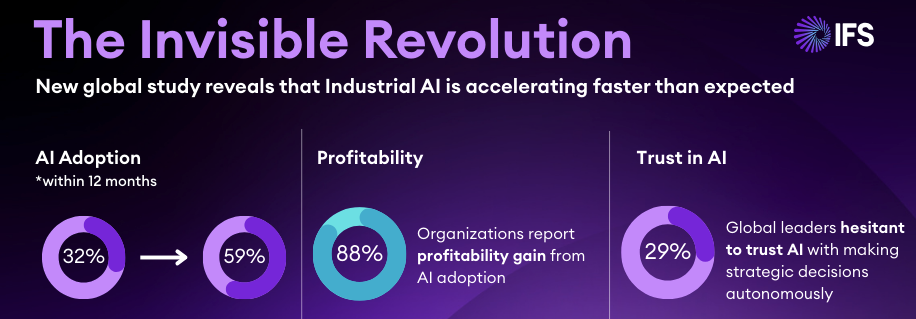
Despite growing confidence in AI’s potential to increase productivity and growth, trust remains a major obstacle. Only 29 percent of Global decision-makers are comfortable letting AI make autonomous strategic decisions (see graphic above), while 68 percent say a human must still confirm or approve AI-generated results. Concerns about bias also remain – particularly in the US, where 63 percent of respondents cite this as a major concern, compared to just 40 percent in the Nordics. However, it is positive that 65 percent of global decision-makers support the establishment of an independent, international regulatory body for AI, to reduce the trust gap.
Industrial AI Requires New Business Models
While generative AI has been recognized for its revolutionary impact on employee productivity and creative tasks, it is industrial AI that is reshaping the way companies operate in a more fundamental way. It is deeply integrated into core operations, automating maintenance, predicting disruptions, optimizing supply chains and orchestrating intelligent decision-making across field service, asset management and manufacturing.
This is not a vision of the future, but something that is already happening. The study shows that 54 percent of all global businesses are using automated AI today, while 45 percent are using predictive AI. Already, 35 percent are experimenting with agent-based AI, which can make decisions autonomously in workflows. Traditional business models are beginning to be impacted by AI, and 77 percent of global decision-makers say the technology is accelerating servitization. That is, a shift from selling products to delivering outcomes-based services, where companies deliver uptime, performance, and continuous value rather than just physical goods.
“This is a bold new era where AI is redefining how industries create and deliver value. Industrial AI is moving into real-time, decision-grade intelligence embedded across the enterprise. It’s already securely automating the complex, predicting the unexpected, and powering new service-led business models. This is about shifting from tasks to transformation, and the organizations who embrace that shift will lead the next industrial chapter,” commented Sharma.
The Clock is Ticking
The IFS study indicates that we have entered a new phase for AI in the enterprise, no longer confined to innovation labs, but driving business forward. The next 12 months will be crucial, as the businesses that bridge the AI divide now will shape the industrial leadership of the future.
“We are experiencing one of the most profound and underappreciated changes in the global business world,” concludes Kriti Sharma. “Industrial AI is here, and is already reshaping how entire industries operate, compete, and grow.”

