


Siemens’ PLM platform, Teamcenter, possesses an undeniable prowess as a developer of PLM solutions tailored for discrete manufacturing—or, frankly, manufacturing at large—a fact explicitly noted by Gartner. This was the undisputed reality in 2023 when Gartner released its latest Magic Quadrant for MES (Manufacturing Execution Systems), and the narrative remains unchanged now that Gartner has unveiled its June report: the ”2026 Gartner Magic Quadrant for PLM Software in Discrete Manufacturing Industries.”
In short, no other developer in the PLM industry offers solutions that are as powerfully, seamlessly interconnected and deeply integrated. Siemens excels at bridging the digital tools across every single domain critical to modern product development today. This spans most things from mechanics, electrical engineering, electronics, and software development, all the way to manufacturing, testing, and machining.
Naturally, this is of paramount importance in a production ecosystem where Gartner’s authors—led by Marc Halpern and Sundip Pattanayak—assert that PLM systems are charging forward at an unstoppable pace: ”By 2030, more than 60% of manufacturers are expected to rely on PLM as a core system to enable AI-driven product innovation and development, up from approximately 20% today.”
The Big Three Continue to Hold Their Ground
Before moving forward, let us unpack the concept of discrete manufacturing: the art of producing distinct, countable units assembled from individual components, ranging from sleek automobiles and roaring airplanes to cutting-edge smartphones and machinery. Conversely, process manufacturing churns out goods in bulk—liquids, gases, or powders—guided by precise formulas, with products measured by volume or weight rather than being tracked one by one.
How do the specialists at Gartner judge the battlefield, and where do they see the market players positioning themselves?
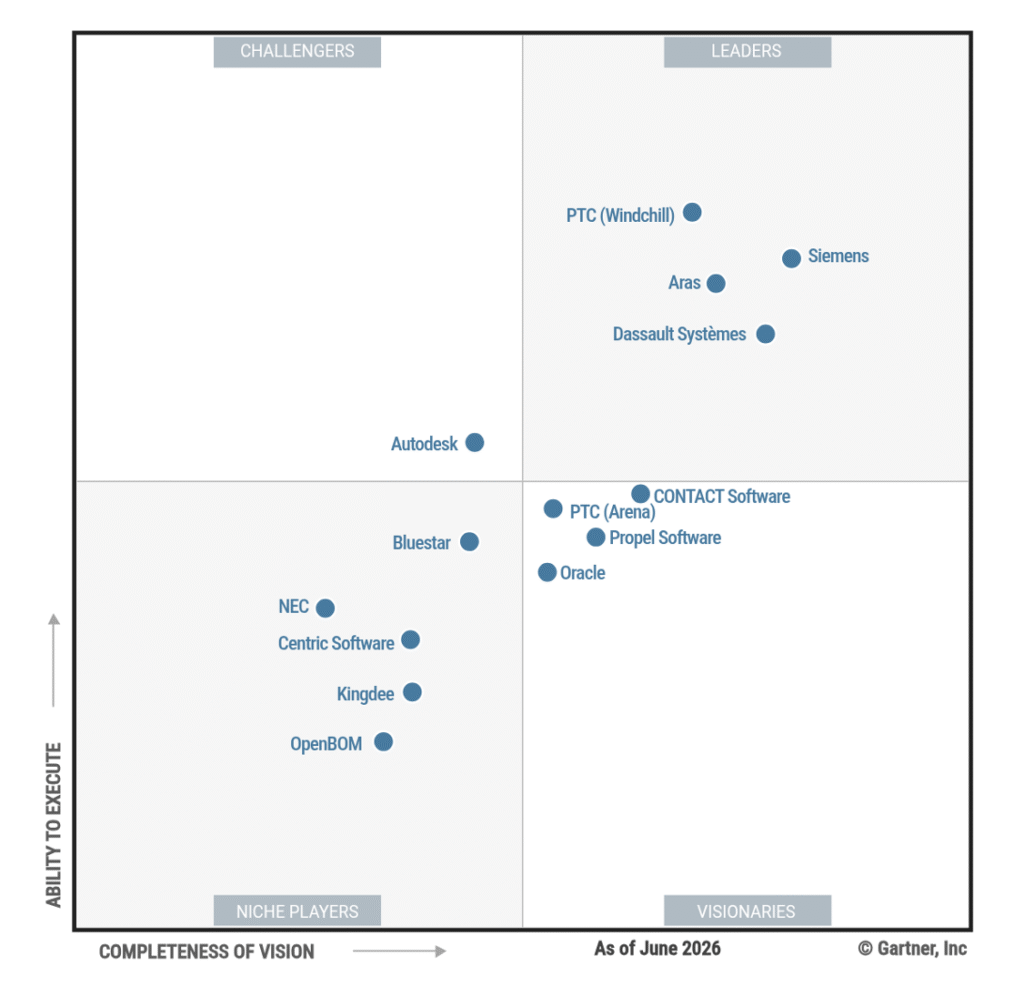
It doesn’t come as a surprise that the Leaders Quadrant in Gartner’s 2026 Magic Quadrant for Manufacturing PLM features the industry’s ”Big Three”—Siemens, PTC, and Dassault Systèmes—firmly established as the dominant market leaders. Aras PLM has disrupted the elite tier, securing a coveted spot for its Innovator PLM platform among the frontrunners.
”As AI reshapes how products are designed, built, and operated, we remain focused on delivering PLM solutions that scale securely and connect data, people, and processes from end to end.” She added that the software delivers AI built specifically for PLM. With AI embedded directly into Teamcenter, customers gain seamless access to advanced AI capabilities, fully integrated with their secure, connected digital thread backbone. Users can leverage Teamcenter Copilot for generative AI-driven assistance, with increasing expertise introduced in every new product release. Beyond AI, other key areas of investment that Siemens believes contributed to Gartner’s recognition as a Leader include Bill of Materials (BOM) enhancements to connect the digital thread, and the success of Teamcenter X—Siemens’ cloud-based SaaS delivery option that makes Teamcenter accessible to businesses of all sizes and complexities.
Siemens Emerges as the Undisputed Market Leader with Teamcenter
Standing tall at the absolute forefront of the four industry titans in the Leaders Quadrant is Siemens and their powerhouse Teamcenter platform. Gartner analysts highlight that ”their product, Teamcenter, offers comprehensive product lifecycle management, built upon an extensive digital thread that seamlessly bridges mechanical, electrical, software, manufacturing, and service domains.”
The evaluation report further notes that the company’s operations are globally diversified, with a customer base that primarily spans large to mid-sized enterprise levels. These clients typically operate within highly complex, heavily regulated discrete manufacturing sectors, including aerospace and defense (A&D), automotive, high-tech, semiconductors, and medical devices.
Gartner also emphasizes that Siemens is pouring heavy investments into industrial AI, spearheaded by Teamcenter Copilot and digital thread agents. Simultaneously, they are aggressively expanding their scalable SaaS and hybrid PLM offerings, alongside highly tailored, industry-specific solutions.
Siemens Strengths
* Integrated Portfolio Clarity: ”Clients benefit from Siemens’ alignment with enterprise PLM purchasing patterns through an account-based strategy that engages cross-functional stakeholders across IT, engineering, and operations. The consolidation of capabilities within their digital thread and manufacturing portfolios helps enhance the clarity of their offerings, making PLM solutions easier to evaluate and assess,” notes Gartner.
* Market-Driven Innovation: ”Siemens demonstrates a robust response to market demands. Recently launched versions have introduced AI-assisted productivity and lifecycle intelligence features, particularly tailored for electronics and software-defined products. The integration of advanced simulation and analytics, while maintaining openness, further strengthens support for digital twins. Furthermore, customer feedback highlights steady improvements in usability.”
* Overall Viability: ”Siemens exhibits consistent customer growth and sustainable technology investments, which underpin a credible long-term vision. The customer perception of Siemens as a reliable, long-term partner further highlights its viability, especially within highly regulated industries.”
Keep an eye out for…
* The moving target of pricing and sales complexity: When Gartner talk about Siemens shifting gears toward subscription and SaaS models they note that in some cases, this move has triggered some pretty unpredictable price swings—especially for customers making the leap from traditional perpetual licenses. On top of that, their highly modular portfolio and complex licensing setups can make buying a real headache. You will want to look over those contracts with a magnifying glass to fully grasp your actual rights and upcoming renewal costs.
* The bumps in the road during execution: When digging into Gartner inquiries, some clients are running into roadblocks when trying to execute an end-to-end digital thread. This is especially true for complex scenarios that require weaving together multiple systems, like connecting PLM with ALM, ERP, and MES. Because of this, massive enterprise rollouts usually demand heavy configuration, endless tweaking, and multiple iterations. That means more heavy lifting and a much longer wait to see the actual results you want.
* A partner network that doesn’t quite click: Even though the platform boasts a massive portfolio backed by plenty of dedicated tech and implementation partners, the actual software solutions and partner delivery models don’t always hold hands.
”Engineers often spend hours searching for buried answers in Windchill—hidden within old reports and documentation,” he explained. ”As this wasted time grows, the risk of losing institutional knowledge rises, too”. The Windchill AI assistant changes this by allowing natural language queries that generate contextual answers from the user’s own data, with every insight linked to its source and respecting access controls. Delivered as a plugin, it enables instant implementation without a major system overhaul.
PTC’s Windchill: Razor-Sharp Connections Bridging Mechanics and Software
Gartner notes that PTC’s PLM software, Windchill, provides a rigorously governed system of record for product data, serving as the definitive digital thread and backbone that seamlessly unifies engineering, software development, and manufacturing value streams.
The analyst further points out that PTC’s operations and customer base are geographically diversified, successfully targeting midmarket and large-scale enterprise manufacturers across the aerospace and defense, automotive, electronics, industrial, and medical device sectors.
Indeed, within the PLM landscape, PTC has earned a reputation as a fierce champion for SaaS solutions and the cloud. In its SaaS lineup, the company highlights Windchill+ as a highly scalable cloud platform specifically engineered to support mid-sized to large enterprises with complex product development needs. This deeply sets it apart from the vendor’s other PLM product, Arena, which is primarily optimized for midmarket operations and less intricate use cases. Moving forward, beyond embedding advanced AI capabilities, their future roadmap focuses heavily on modernizing UI/UX, reinforcing ALM connections, and delivering enhanced supply chain support.
Core Strengths of Windchill
* A Sharp Focus on Complex Industries: Gartner writes that PTC empowers advanced manufacturing sectors by seamlessly bridging the gap between mechanical and software engineering. By integrating robust product lifecycle management features with Codebeamer (PTC’s application lifecycle management software), the platform forges an unbroken digital thread that significantly elevates both hardware and software traceability. As industry analysts summarize, this architectural synergy enables clients to effortlessly navigate high complexity and rapidly evolving demands throughout the entire product lifecycle.
* Unrivaled Operational Reliability: Extensive customer feedback and global market insights spotlight PTC’s steadfast operational execution. They confirm that Windchill’s long-term system stability aligns perfectly with the brand’s promise to its users. By remaining firmly anchored to its core PLM competencies while successfully championing practical, AI-driven use cases—such as intelligent parts reuse and in-depth change-impact analysis—PTC delivers tangible business value that supercharges everyday engineering workflows.
* Enterprise-Grade Scalability: Windchill successfully fuels massive, global deployments with enduring system stability and enterprise-tier licensing. This immense capability is heavily driven by its ePLM packaging model and its robust, dynamic support for organizational change management. Furthermore, standardized and role-based licensing structures significantly simplify user adoption and overarching governance across highly complex, globally distributed organizations.
Critical Watch-Points for Enterprise PLM
* A Moderating Pace of Innovation: According to Gartner’s market research surrounding client experiences, some enterprise users point out that the platform modernization of Windchill is lagging behind its fierce competitors. This deceleration is felt most acutely when examining core AI-ready data architectures and agent-based AI capabilities. While PTC is actively addressing these areas, customers are voicing a strong desire for more rapid execution and visibly tangible progress.
* The Hunt for Intuitive UI/UX: A subset of users find that Windchill’s user interface and operational workflows can feel highly unintuitive—especially for brand new or casual users—when compared to today’s sleek, modern enterprise applications.
* Packaging and Value Complexity: Customer inquiries suggest that various organizations are struggling to align their software licensing costs with true business value. This friction stems from PTC’s frequently evolving packaging models and the industry-wide transition toward Windchill+ and ePLM. Consequently, this creates significant hurdles in accurately forecasting upfront expenses. Interestingly, according to Gartner, this exact same sentiment is currently echoing among clients of industry titan Siemens.
A Few Words on Dassault Systèmes ENOVIA on the 3DEXPERIENCE Platform
Dassault Systèmes’ flagship solution, ENOVIA, is most widely celebrated as a robust, model-based powerhouse for product development and PLM. Gartner highlights that, ”ENOVIA is driven by the 3DEXPERIENCE (3DX) platform, which provides a completely unified, seamless environment for design, simulation, manufacturing, and lifecycle management.”
The vendor commands a formidable and dominant presence across all major global geographical regions. Furthermore, the company’s footprint is exceptionally strong among large enterprises and heavy-hitting OEMs within highly complex discrete manufacturing sectors—most notably across aerospace and defense (A&D), the automotive industry, and industrial equipment manufacturing.
Another highly notable takeaway is Dassault’s aggressive strategy to deeply embed AI via their cutting-edge ”Virtual Companions.” This innovative move dynamically links AI-generated experiences directly with virtual twins, dramatically elevating and supercharging ecosystem interoperability.
ENOVIA’s Core Strengths
* Deep-Rooted Engineering Excellence: ”Dassault fiercely champions complex, engineering-intensive discrete manufacturing industries through its heavily integrated CATIA, SIMULIA, and DELMIA portfolio. The seamless integration of model-based systems engineering (MBSE) alongside cutting-edge virtual twin capabilities within the PLM framework dramatically elevates and refines cross-disciplinary, interdisciplinary collaboration.”
* Industry-Specific Expertise: ”Dassault strategically leverages its rich, deep-seated expertise in product development and manufacturing to deliver highly specialized, industry-tailored PLM solutions. This targeted approach shines particularly bright within the construction, infrastructure development, and automotive sectors.”
* An Unwavering Focus on Security and Sovereignty: Here, the analyst highly praise and spotlight that Dassault’s OUTSCALE sovereign cloud infrastructure boasts Europe’s absolute highest cloud security certification. Working hand-in-hand with this ironclad infrastructure is a clear, deliberate strategy for ”AI independence.” This unique framework empowers enterprise customers to confidently deploy secure, sovereign Large Language Models (LLMs) without worrying about locking their highly sensitive corporate data into a single, restrictive AI vendor.
What to watch out for…
* High Implementation Complexity: ”Deploying 3DX platforms typically demands extensive process restructuring, ironclad data model alignment, and a meticulous containment of customizations. Customer inquiries reveal that certain large enterprises—particularly Dassault’s legacy clients anchored in complex, older environments—are actively struggling to migrate their existing tools, data models, and ongoing projects into the 3DX ecosystem.”
* A Muddled Value Proposition: ”Dassault’s highly complex messaging makes it difficult for customers to clearly grasp the product’s day-to-day operational value.”
* Interoperability Anxieties: ”During client inquiries, several customers operating within highly heterogeneous environments voiced serious concerns over the intense pressure to adopt Dassault’s entire platform stack. This lock-in severely chokes flexibility inside mixed-vendor ecosystems.”
ARAS PLM Innovator – A Rising Challenger on the Move
One player increasingly capturing the spotlight and climbing to the very top of analyst scorecards is ARAS Innovator. According to Gartner, this platform zeroes in on delivering digital thread-enabled PLM solutions. It leverages an open, flexible, and model-driven architecture designed to seamlessly connect product data and processes across the entire lifecycle. Gartner:
”The vendor’s operations are geographically diversified, boasting a robust direct presence across North America, Western Europe, and Japan. Its clientele typically consists of midmarket and large enterprise organizations spanning sectors such as industrial machinery, shipbuilding, automotive, aerospace and defense, high-tech electronics, and medical device manufacturing.
Aras is heavily investing in expanding its cloud-native offerings and developing highly targeted, industry-specific solutions. Furthermore, the vendor is advancing its InnovatorEdge AI framework, empowering customers to build, deploy, and securely govern agentic AI workflows right across the digital thread.”
Aras PLM-styrkor
* Scalable Platform: Customers can deploy Aras incrementally by leveraging its freemium Community Edition for evaluation and smaller rollouts, enabling a uniquely low-risk strategy.
* Governed Agentic AI: Aras InnovatorEdge AI empowers organizations to build, deploy, and govern agentic AI workflows directly within the PLM environment, including the configuration of core PLM capabilities.
* Predictable Costs: Aras stands out from the crowd with a straightforward subscription model that completely avoids functional, module-based pricing and champions absolute price transparency.
Watch Out For…
* Limited Vertical Support: Aras remains fundamentally a horizontal solution, meaning it must be tailored and configured to meet certain industry-specific needs.
* Limited Functional Maturity: During Gartner inquiries, customers reveal that the overall completeness of Aras PLM doesn’t always pace the developer’s ambitious digital thread and AI vision.
* Limited Manufacturing Execution System (MES) Integration: Aras currently lacks mature, out-of-the-box MES integrations. Consequently, organizations must rely on custom or third-party solutions to effectively bridge the gap between engineering and shop floor operations.

