



According to Amit Gupta, the modern electronics industry is navigating a period of unprecedented complexity, driven by the convergence of AI, 5G and software-defined technologies. This environment presents significant obstacles that Siemens is addressing through digitalization, AI and advanced EDA tools.
Key challenges confronting the industry include:
1. Assembly design and system complexity
2. Fast delivery times and productivity pressures
3. Supply chain volatility and sustainability
4. Talent shortage and skills gap
5. Verification and data management
Against this backdrop Amit Gupta says that Fuse EDA AI Agent represents the next evolution of Siemens Fuse EDA AI system, moving from in-tool AI capabilities to autonomous, end-to-end workflow orchestration.
”We are delivering intelligent automation across the complete EDA lifecycle, enabling our customers to dramatically reduce design cycles while maintaining the highest quality standards. Our open architecture allows customers to integrate their own workflows and models, providing the flexibility required for enterprise-scale AI deployment. This positions the industry to maintain a competitive advantage in an increasingly complex semiconductor and PCB system landscape.”
Fuse EDA AI Agent builds upon Siemens’ Fuse EDA AI system, which features a sophisticated RAG pipeline, a multimodal EDA-specific data lake, specialized parsers for EDA file formats, customizable access controls, support for multiple AI models and an open approach for third-party integrations.
Comprehensive Coverage of the Entire Semiconductor and PCB System Workflow
In the press material Siemens writes that Fuse EDA AI Agent delivers comprehensive domain-wide automation by planning, orchestrating, and executing processes across the entire design lifecycle. In the front-end design and verification phases, Fuse Agent supports the automation of architecture exploration, design planning, and register-transfer level (RTL) coding with Siemens Catapult software. For digital verification, Fuse Agent assists with test bench generation, debugging, and more through integration with the recently launched Questa One Agentic Toolkit.
As the design progresses to physical implementation, Fuse Agent assists with place-and-route calculation, timing closure, and power optimization through direct integration with Siemens Aprisa software. Fuse Agent accelerates custom design and verification with Siemens Solido software, along with hardware-assisted verification with the Veloce™ hardware-assisted verification and validation system. Fuse Agent also accelerates physical verification signing by automating the analysis and resolution of design rule control (DRC) violations through integration with industry-leading Calibre® software. For 3D ICs, it drives power/ground loading optimization and automated clustering of signal path plans in I nnovator3D IC software. For PCB systems, it assists with layout, signal integrity, and other analysis in Xpedition software and Hyperlynx software. It also supports the manufacturing readiness workflow through Tessent software for design-for-test (DFT) workflows and integration with Calibre optical proximity correction (OPC) products.
Key Features of Fuse EDA AI Agent
Standard AI tools struggle with semiconductor and PCB system design because they lack the proprietary domain knowledge needed to interpret dense, physics-based EDA data. Generic agentic AI platforms may also introduce IP risk considerations, including the possibility of inadequate access controls across folders and documents, as well as the potential for sensitive design data to be inadvertently exposed through native internet or cloud resource usage. Finally, the sheer density of modern tool chains quickly overwhelms generic models, leading to context saturation and hallucinations.
Fuse EDA AI Agent addresses these challenges by providing:
Domain-specific expertise: While generic agentic solutions struggle with EDA workflows, Fuse EDA AI Agent delivers intelligent automation based on Siemens’ deep understanding of semiconductor and PCB system workflows and specialized tool relationships. It orchestrates multi-tool and multi-agent EDA workflows while preventing errors through built-in validation and domain-specific guardrails. Fuse Agent supports Agent Skills, enabling executable playbooks that accurately complete complex, multi-step tasks across EDA workflows by integrating domain-specific knowledge. This empowers designers to seamlessly customize these playbooks to meet their specific requirements.
Scalable AgentOps and MCP architecture: Fuse EDA AI Agent performs dynamic tool discovery and orchestration across MCP-connected EDA tools, uses hierarchical planning with a supervisor agent and worker agents, and includes autonomous recovery loops. This enables seamless integration with Siemens’ EDA tools and third-party tools, providing a true multi-vendor tool solution. This approach mitigates context-window saturation across multiple MCP uses and streamlines the designer-agent experience.
Enterprise infrastructure and data orchestration: Fuse EDA AI Agent is built for high-performance in EDA environments as it optimizes resource allocation across existing scheduling frameworks and high-performance computing (HPC) clusters while maintaining enterprise-scale workflow reliability. Centralized data handling enables teams to leverage existing infrastructure and gain cross-workflow insights within air-gapped compute environments.
Embedded security and governance: There is native support for role-based access controls, audit trails and human checkpoints that enable trustworthy automation in secure EDA environments, thereby safeguarding sensitive design IP from external exposure.
”Seamless orchestration across complex EDA environments is crucial as the industry continues to advance semiconductor technologies. Samsung is pleased to introduce Siemens’ Fuse as a key enabler for cutting-edge design strategies within our agentic semiconductor workflows,” said Jung Yun Choi, executive vice president of Memory Design Technology, Samsung Electronics. ”With its purpose-built architecture and interoperable framework, Fuse is expected to accelerate our move beyond traditional automation, enhancing engineering productivity and design excellence.”
Collaboration with NVIDIA
Siemens and NVIDIA are deepening their strategic partnership to advance the next generation of autonomous and long-running agents for semiconductor and PCB system design. By collaborating with NVIDIA, Siemens enables the offloading of specialized and time-intensive processes to autonomous agents, so that organizations can achieve a new level of operational expertise and capabilities previously impossible. At the core of this partnership is Fuse EDA AI Agent, which seamlessly supports NVIDIA GPUs and Nemotron models optimized for reasoning and tool-calling reliability, enhancing RAG accuracy across multimodal data and ensuring dependable execution of complex EDA workflows. NVIDIA Nemotron models provide high precision and increased throughput for agentic EDA tool calls, achieving frontier-model parity while significantly reducing token cost.
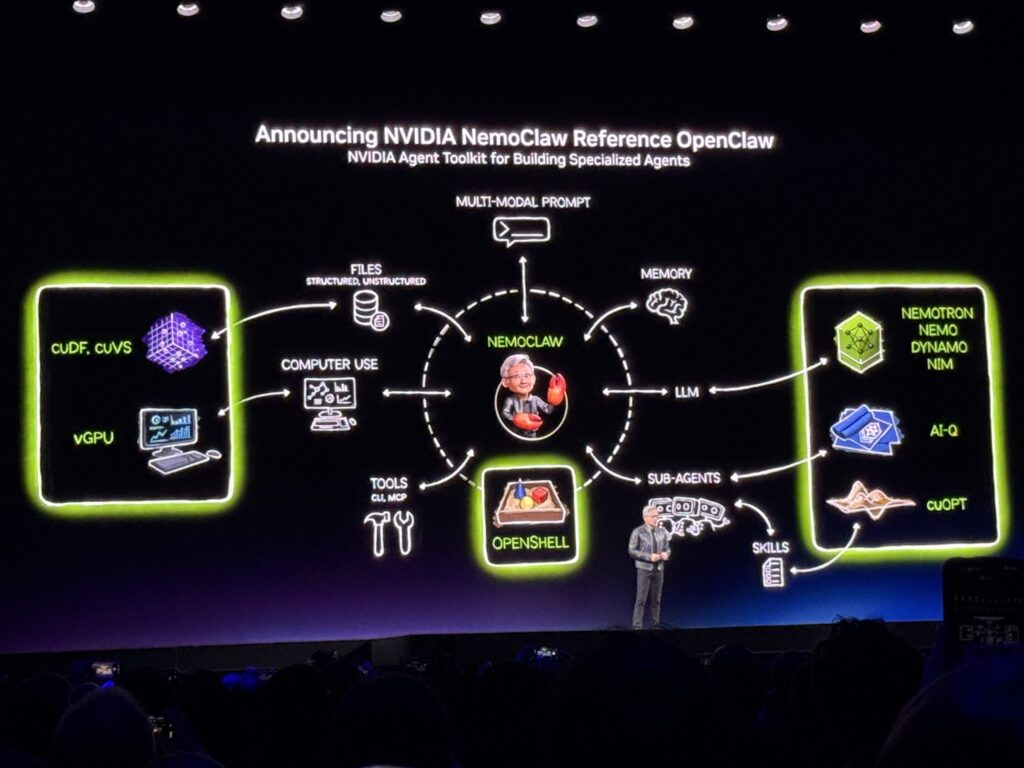
Looking ahead, Siemens plans to enhance Fuse Agent’s capabilities with NVIDIA’s expanding enterprise-grade agentic AI stack, including NVIDIA NemoClaw, an open source stack that simplifies running OpenClaw always-on assistants, more safely, with a single command. As part of the nVIDIA Agent Toolkit, it installs the NVIDIA OpenShell runtime – a secure environment for running autonomous agents and open source models like NVIDIA Nemotron. This cements Fuse EDA AI Agent and Fuse EDA AI system as an industrial-grade solution for autonomous EDA automation.
“Together with Siemens, we are charting the next era of agentic AI, where long-running agents can safely operate engineering tools and coordinate complex tasks,” said Kari Briski, vice president of generative AI, NVIDIA. “By combining Siemens Fuse Agent with NVIDIA agentic AI technologies, we’re laying the foundation for agents that can plan, act, and adapt across design workflows.” NVIDIA uses the Siemens Fuse EDA solution in its chip development. The collaboration accelerates the industry’s move beyond traditional automation toward intelligent, domain-aware autonomous agents.
NVIDIA uses Siemens’ Fuse EDA solution in its chip development. The collaboration accelerates the industry’s move beyond traditional automation toward intelligent, domain-aware autonomous agents.

The broadest portfolio on the market
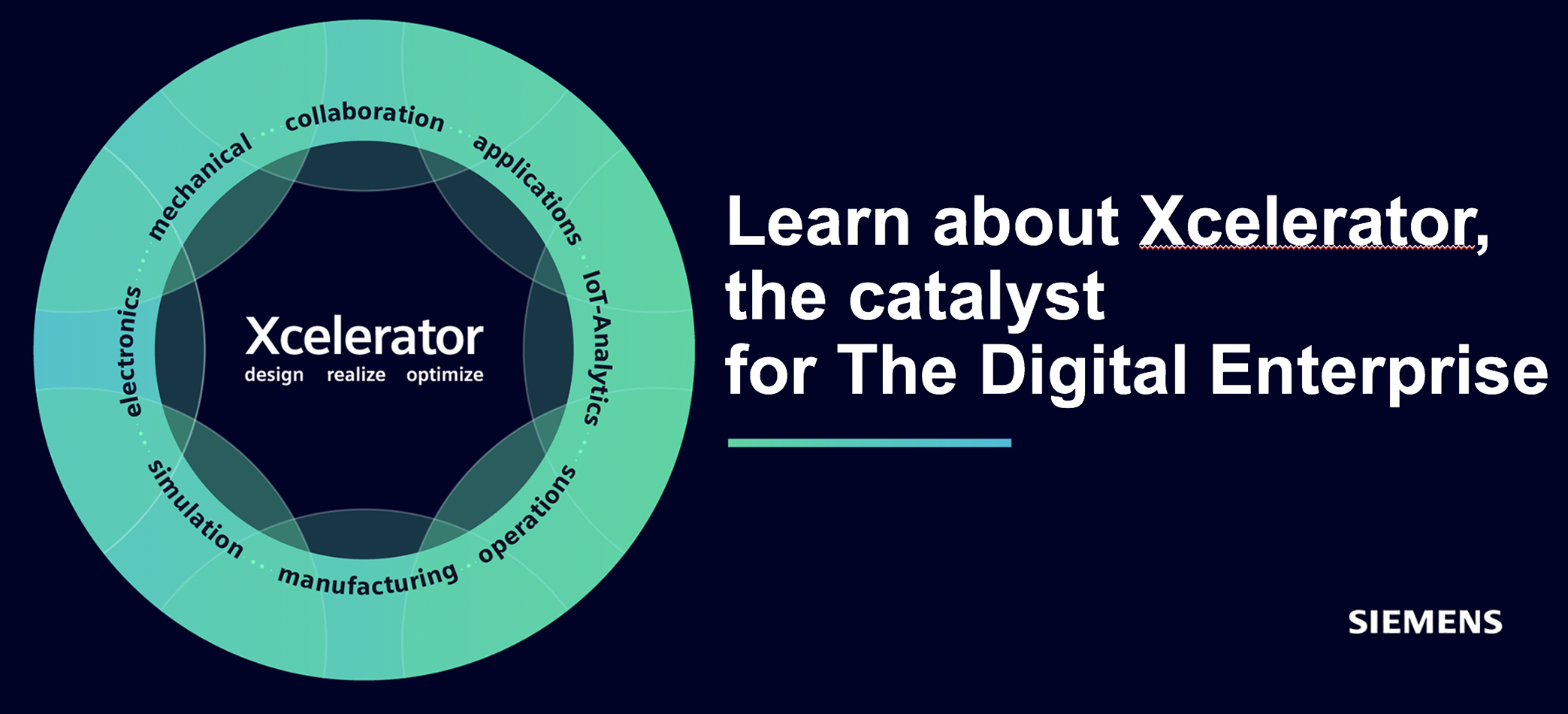
An interesting aspect of Siemens Digital Industries Software is the breath of what the company is offering the market in everyting from product development to manufacturing, and even solutions to support their products in the hands of their custromers end-users. The software, hardware, and services based on Siemens Xcelerator business and PLM portfolios are unique in the business.
Siemens software and the comprehensive digital twin enable companies to optimize their design, engineering, and manufacturing processes to turn today’s ideas into tomorrow’s sustainable products. From chip to entire systems, from product to process, across all industries. Siemens Digital Industries Software – Accelerating Transformation.
Generally, Siemens Digital Industries Software is heavily investing in the future of industrial digitalization, aiming to merge the real and virtual worlds through the industrial metaverse, artificial intelligence (AI), and a comprehensive digital twin portfolio. The company is shifting towards a software-defined enterprise model, moving away from hardware-specific limitations to offer flexible, cloud-based, and autonomous manufacturing solutions.
Their goal is to create the complete suite of tools needed for a truly ”comprehensive digital twin,” which mimics physical objects throughout their entire lifecycle. And elecxtronics plays an important role: Its electronics strategy is developing toward an AI-native, software-defined, and fully integrated ”digital twin” future. By combining its electronic design automation (EDA) tools with comprehensive manufacturing, mechanical, and lifecycle management software (Teamcenter) within the Siemens Xcelerator portfolio, the company is bridging the gap between chip design, PCB manufacturing, and final physical products.

