

Hydrogen Heavyweights: Toyota Joins Volvo & Daimler in Massive Fuel Cell Pact
In a major automotive shake-up, Toyota Motor Corporation has signed a non-binding memorandum of understanding (MOU) to join Daimler Truck AG and the Volvo Group in their fuel cell joint venture, Cellcentric. Founded in 2021 by the Swedish and German giants, Cellcentric focuses on developing, producing, and commercializing hydrogen fuel cell systems for heavy-duty trucks and sustainable transportation, with operations in Germany and Canada.
This move marks a significant shift in the hydrogen landscape. By joining Volvo and Daimler as an equal partner, Toyota—a pioneer in hydrogen technology—is set to accelerate the commercialization of fuel cells as a key technology for decarbonizing long-haul transport. The partnership allows the companies to combine Toyota’s deep knowledge with existing expertise, bringing significant commercial opportunities and sharing the substantial R&D costs associated with hydrogen technology.
"Welcoming Toyota onboard will be a big leap towards realising decarbonisation of our industries," said Martin Lundstedt, President and CEO of Volvo Group.
Following the closing of the transaction, Toyota intends to contribute its complementary technical know-how to the joint venture, solidifying cellcentric's position as a global leader in fuel cell systems. The initiative highlights the critical role of hydrogen as a long-term solution alongside battery-electric alternatives in the automotive industry's green transition.
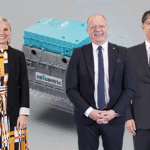
Volvo Group CEO Martin Lundstedt (center) states in a comment that the partnership with Toyota through cellcentric can accelerate and create critical mass for hydrogen applications.
“Absolutely, and this is an important signal to customers, suppliers, and others in the ecosystem. Given the importance of accelerating the transition to net-zero transport, the need for great companies to join forces and collaborate is more crucial than ever. Welcoming Toyota onboard will be a major step towards realizing the decarbonization of our industries,” he adds.
Volvo, Daimler, Cellcentric, and Toyota will, therefore, continue to jointly develop the fuel cell systems expected to have a major impact on the commercial vehicle industry.
Karin Rådström (left), CEO of Daimler Truck, says that “this will enable us to strengthen development and further scale up hydrogen technology”. Right: Toyota CEO Koji Sato.
Regarding PLM tools, Cellcentric works primarily in the same solutions as Volvo Group: PTC’s Creo CAD and Windchill PLM. For its manufacturing processes the joint venture company uses SAP software to manage its operations, specifically implementing SAP S/4HANA Cloud for ERP and SAP Digital Manufacturing to support the mass production.
Click on the headline to read the full story on PLM&ERP News.
This move marks a significant shift in the hydrogen landscape. By joining Volvo and Daimler as an equal partner, Toyota—a pioneer in hydrogen technology—is set to accelerate the commercialization of fuel cells as a key technology for decarbonizing long-haul transport. The partnership allows the companies to combine Toyota’s deep knowledge with existing expertise, bringing significant commercial opportunities and sharing the substantial R&D costs associated with hydrogen technology.
"Welcoming Toyota onboard will be a big leap towards realising decarbonisation of our industries," said Martin Lundstedt, President and CEO of Volvo Group.
Following the closing of the transaction, Toyota intends to contribute its complementary technical know-how to the joint venture, solidifying cellcentric's position as a global leader in fuel cell systems. The initiative highlights the critical role of hydrogen as a long-term solution alongside battery-electric alternatives in the automotive industry's green transition.
Volvo Group CEO Martin Lundstedt (center) states in a comment that the partnership with Toyota through cellcentric can accelerate and create critical mass for hydrogen applications.
“Absolutely, and this is an important signal to customers, suppliers, and others in the ecosystem. Given the importance of accelerating the transition to net-zero transport, the need for great companies to join forces and collaborate is more crucial than ever. Welcoming Toyota onboard will be a major step towards realizing the decarbonization of our industries,” he adds.
Volvo, Daimler, Cellcentric, and Toyota will, therefore, continue to jointly develop the fuel cell systems expected to have a major impact on the commercial vehicle industry.
Karin Rådström (left), CEO of Daimler Truck, says that “this will enable us to strengthen development and further scale up hydrogen technology”. Right: Toyota CEO Koji Sato.
Regarding PLM tools, Cellcentric works primarily in the same solutions as Volvo Group: PTC’s Creo CAD and Windchill PLM. For its manufacturing processes the joint venture company uses SAP software to manage its operations, specifically implementing SAP S/4HANA Cloud for ERP and SAP Digital Manufacturing to support the mass production.
Click on the headline to read the full story on PLM&ERP News.

AI-Driven Logistics That Delivers: ”IFS and 7bridges Redefine the Playing Field”
“Creates value within just a few weeks,” says Philip Ashton, President of IFS.ai Logistics.
In recent years, IFS has successfully pioneered industrial AI solutions, propelling the company to the forefront of the global ERP arena. A pivotal move in this strategic evolution was the August 2025 acquisition of 7bridges, a specialist in logistics and transport optimization. By integrating 7bridges’ AI-powered simulation and analytics tools into the IFS Cloud platform, IFS aims to provide customers in asset-intensive sectors—such as manufacturing, aerospace, and defense—with a more robust and comprehensive supply chain management system.
Today, that vision has evolved. With last week’s launch of IFS.ai Logistics, the company unites AI-driven planning, automated operations, freight cost auditing, and network optimization into a seamless, closed-loop workflow. The result? Transforming logistics from a complex cost center into a strategic competitive advantage.
It’s easy to see why logistics and transport optimization are mission-critical for industrial AI. Most industrial operations are, at their core, defined by flows. Managing these effectively is the linchpin of business success. Thanks to the data explosion of recent years, we now possess the data-driven technologies required to automate, predict, and optimize complex flows in real-time.
When these digital tools are integrated into both PLM and ERP systems, the impact is immediate: heightened efficiency and reduced costs across industrial processes. The ultimate goal is clear: leveraging AI to transform logistics from manual, reactive tasks into smart, proactive, and automated systems. And that is exactly where IFS positions itself today.
With its new solution, IFS is integrating industrial AI directly into the physical material and goods flows that form the backbone of industrial operations worldwide. Having already managed $2.4 trillion in mission-critical assets for its customers, IFS is now adding a layer of intelligent logistics with IFS.ai Logistics, connecting operational decisions to financial results across the entire supply chain.
"Logistics is one of the largest cost centers, yet it is often the least controlled and most vulnerable to disruption, with consequences directly impacting EBITDA," says Philip Ashton (pictured), President of IFS.ai Logistics. "However, we have found that when AI is applied at scale, directly into industry-specific applications like logistics operations, we can generate tangible value for our customers within just a few weeks."
Click on the title to read more on. PLM&ERP News.
In recent years, IFS has successfully pioneered industrial AI solutions, propelling the company to the forefront of the global ERP arena. A pivotal move in this strategic evolution was the August 2025 acquisition of 7bridges, a specialist in logistics and transport optimization. By integrating 7bridges’ AI-powered simulation and analytics tools into the IFS Cloud platform, IFS aims to provide customers in asset-intensive sectors—such as manufacturing, aerospace, and defense—with a more robust and comprehensive supply chain management system.
Today, that vision has evolved. With last week’s launch of IFS.ai Logistics, the company unites AI-driven planning, automated operations, freight cost auditing, and network optimization into a seamless, closed-loop workflow. The result? Transforming logistics from a complex cost center into a strategic competitive advantage.
It’s easy to see why logistics and transport optimization are mission-critical for industrial AI. Most industrial operations are, at their core, defined by flows. Managing these effectively is the linchpin of business success. Thanks to the data explosion of recent years, we now possess the data-driven technologies required to automate, predict, and optimize complex flows in real-time.
When these digital tools are integrated into both PLM and ERP systems, the impact is immediate: heightened efficiency and reduced costs across industrial processes. The ultimate goal is clear: leveraging AI to transform logistics from manual, reactive tasks into smart, proactive, and automated systems. And that is exactly where IFS positions itself today.
With its new solution, IFS is integrating industrial AI directly into the physical material and goods flows that form the backbone of industrial operations worldwide. Having already managed $2.4 trillion in mission-critical assets for its customers, IFS is now adding a layer of intelligent logistics with IFS.ai Logistics, connecting operational decisions to financial results across the entire supply chain.
"Logistics is one of the largest cost centers, yet it is often the least controlled and most vulnerable to disruption, with consequences directly impacting EBITDA," says Philip Ashton (pictured), President of IFS.ai Logistics. "However, we have found that when AI is applied at scale, directly into industry-specific applications like logistics operations, we can generate tangible value for our customers within just a few weeks."
Click on the title to read more on. PLM&ERP News.